
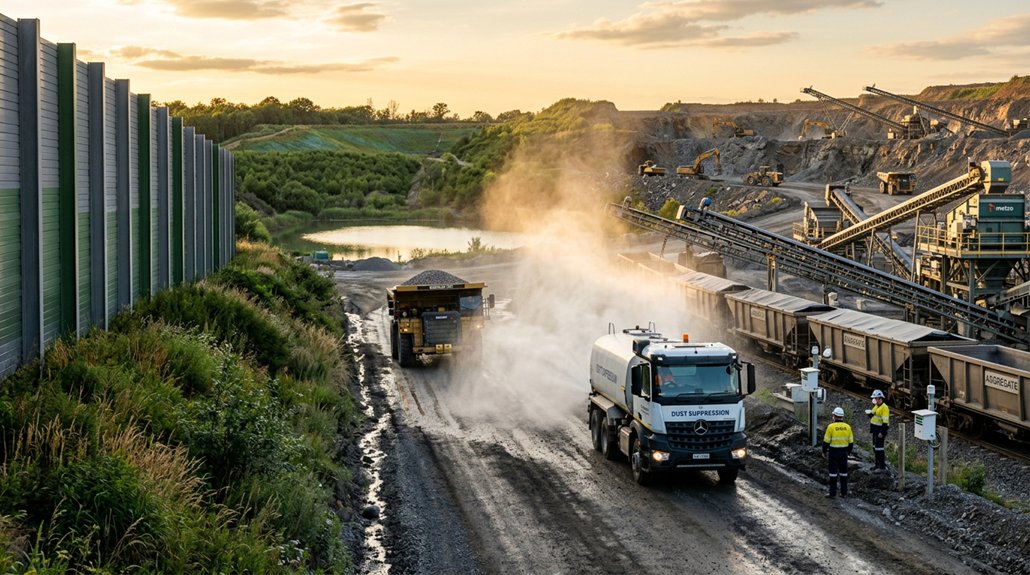
On a dry afternoon, you can see a faint plume trailing a haul truck as the crusher hums behind a berm. Water trucks, misting cannons, and chemical suppressants are essential tools in how quarries manage dust during daily operations. You control that footprint with permit-driven dust and noise plans, targeted water or foam at transfer points, and enclosures on crushers and conveyors. You verify performance using real-time PM and opacity monitoring plus boundary sound measurements. You also manage stormwater, sediment, and spills under BMPs and inspection logs—but the hardest part is where compliance meets community expectations…
Key Takeaways
- Quarries identify dust and noise sources (blasting, crushing, hauling) and set permit-based limits with baseline surveys and action triggers.
- They use real-time PM10/PM2.5 and Class 1 noise monitoring at boundaries and receptors, validating results with periodic gravimetric sampling.
- Dust is reduced using engineered enclosures, negative-pressure ventilation, water or foam sprays, and sealed transfer points with maintained nozzles and controls.
- Road dust and traffic noise are managed with speed limits, surface upgrades, scheduled haulage, and weather-based watering documented by application rates.
- Environmental impacts are minimized with stormwater diversions, detention basins, sediment barriers, and spill prevention using secondary containment, inspections, and trained response.
Main Sources of Quarry Dust and Noise
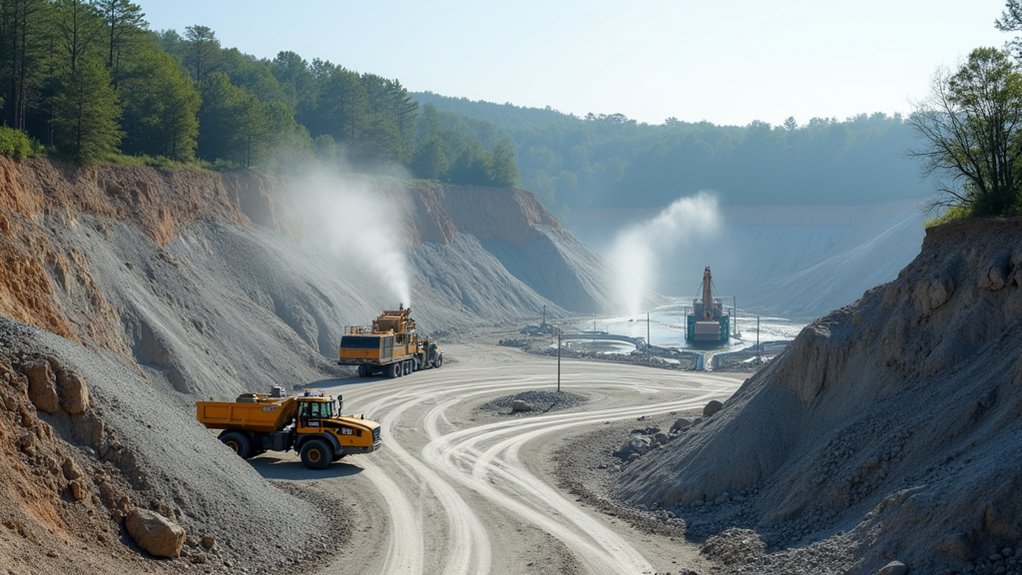
Although dust and noise can originate anywhere on a quarry footprint, you’ll typically trace the highest, most controllable emissions to a few unit operations: drilling and blasting (impulsive overpressure, vibration, and fine particulates), crushing and screening (continuous mechanical noise and process-generated PM10/PM2.5), and materials handling (conveyor transfers, surge piles, and loadout) plus unpaved haul roads where vehicle movement re-suspends deposited fines.
You also generate off-site impacts when wind entrains dry stockpiles or when high dump heights increase plume momentum. You’ll prioritize sources with clear mass- or energy-balance drivers: material throughput, drop height, moisture content, and vehicle speed.
You’ll map receptors and sensitive land uses to show Environmental impact pathways and guide community engagement around schedules, routing, and complaint response.
Quarry Dust and Noise Limits (and Monitoring)
Because regulators and neighbors judge you on measured outcomes—not intent—you’ve got to translate quarry dust and noise into numeric limits and a defensible monitoring plan.
Start by mapping permit conditions and standards: PM10/PM2.5 concentration or deposition rates, opacity limits, and boundary noise criteria like LAeq, Lmax, and tonal penalties by time of day.
Build your baseline with short-term surveys, then set action triggers (e.g., 80% of limit) to force corrective steps before exceedances.
Place real-time particulate monitors downwind and at receptors, validate with periodic gravimetric samples, and log met data to normalize results.
For acoustics, deploy Class 1 meters, track octave bands, and correlate peaks to equipment.
Your quarry dust mitigation and noise reduction strategies must be auditable, trend-based, and complaint-resilient.
Quarry Dust Suppression: Water, Foam, Surfactants
To keep respirable dust within permit and workplace exposure limits, you’ll engineer water spray systems around droplet size, nozzle placement, pressure/flow rate, and control logic tied to real-time monitors.
Where water use is constrained or fines are persistent at crushers, screens, and transfer points, you’ll apply foam dust control to increase capture efficiency and reduce runoff while maintaining compliance.
You’ll also evaluate surfactant additives by wetting time, dosing rate, and percent dust reduction, then document performance to support inspections and corrective actions.
Water Spray System Design
When you design a quarry water spray system for dust suppression, you’re balancing particle capture efficiency against water use, run-off control, and regulatory limits on visible emissions and suspended solids.
Start with a site dust map from environmental assessments, then place sprays at crushers, transfer points, and haul-road intersections where PM10 peaks.
Match nozzle type to duty: full-cone for bulk wetting, flat-fan for belt loading, and misting for fine capture, but avoid over-misting that drifts offsite.
Size pumps for target flow and pressure, then add pressure regulators and solenoid zoning so you only spray when material flows.
Use weather interlocks and VFD control for Water conservation.
Manage runoff with berms, sumps, and sediment basins sized to permit TSS limits.
Maintain nozzles, strainers, and lines weekly.
Foam Dust Control Applications
How do you cut PM10 at crushers and transfer points without driving up water consumption, runoff volume, or TSS risk? You deploy foam dust control where atomized water can’t stay on coarse, fast-moving rock. A low-water foam blanket captures fines at the point of release, improving Dust mitigation at chutes, screens, and surge bins while reducing overspray and ponding.
You tune expansion ratio and application rate to belt speed and material moisture, then verify performance with perimeter PM monitors and visible-emissions checks aligned with permit limits. Because foam applies precisely, you lower cleanup demand and keep stormwater BMPs within design capacity.
Integrate nozzle manifolds with enclosures and noise barriers so you control both fugitive dust and community nuisance. Document settings, inspections, and corrective actions for audits.
Surfactant Additives And Performance
Foam systems work because surfactants lower water’s surface tension, increase wetting on dusty rock, and stabilize bubbles long enough to keep PM10 from re-entraining at crushers, chutes, and transfer points.
You tune performance by selecting Surfactant formulations matched to your ore’s hydrophobicity, fines content, and water hardness, then validating with gravimetric or real-time PM monitors against site limits and permit conditions.
Target consistent bubble size and drainage time; too “dry” rebounds, too “wet” wastes water and can increase runoff.
You also manage additive compatibility with flocculants, scale inhibitors, and belt cleaners to avoid foam collapse, nozzle fouling, or slippery walkways.
Confirm pH range, biodegradability, and effluent impacts to meet stormwater and wastewater requirements.

Capturing Quarry Dust at Crushers and Conveyors
Although primary crushers and transfer points seem like localized emitters, they can drive most of a quarry’s PM10/PM2.5 load because impact fragmentation, belt drop height, and induced air from chute geometry accelerate dust liberation.
You target these sources with engineered enclosure, controlled drop, and capture ventilation sized to maintain negative pressure (e.g., 0.5–1.0 m/s face velocity) without excessive fan energy.
Apply Dust mitigation via foam or atomized sprays at the crusher inlet and belt discharge, but tune nozzle flow to moisture limits and carryback.
Use skirting, sealing, and hooded chutes to cut fugitive loss and reduce housekeeping.
Pair this with Noise reduction by lining enclosures, isolating structure-borne vibration, and selecting low-noise fans.
You document opacity and PM results to meet permit limits and inspection expectations.
Quarry Road Dust: Traffic, Speed, Surface Fixes
Because haul roads generate continuous, mobile emissions, they often dominate a quarry’s fugitive PM10 inventory even when crushers are well-controlled. You’ll cut emissions fastest by managing traffic: cap vehicle counts, separate light vehicles from haul trucks, and schedule loads to avoid queuing.
Set enforceable speed limits (often 10–15 mph) and verify with GPS/telematics; lower speed reduces silt entrainment and improves compliance evidence for permits and nuisance-dust ordinances.
Upgrade surfaces with well-graded aggregate, binding agents, or asphalt on high-traffic segments; keep crowns and ditches functional to prevent fines from pumping.
Apply water based on evaporation and wind, not habit, and document rates. Treat road condition audits as quarry maintenance.
Use community engagement to share monitoring results and complaint-response times.
Quarry Noise Controls: Equipment, Berms, Upkeep
When you map noise by source and receptor—rather than relying on overall dB(A) readings—you can target controls that actually move the compliance needle at property lines and sensitive receptors. You’ll prioritize engineering controls: retrofit exhaust mufflers, line chutes, and add variable-speed drives to cut tonal peaks. You’ll use berms and stockpiles as barriers, ensuring crest continuity and no gaps along line-of-sight. Equipment maintenance matters: worn idlers, loose guards, and damaged fan blades add measurable dB; you’ll log inspections and correct defects before exceedances trigger notices. For environmental compliance, you’ll document pre/post measurements, calibrations, and operating conditions to defend results against permit limits.
| Control | Typical effect | Verification |
|---|---|---|
| Mufflers/liners | 3–8 dB | source checks |
| Berms | 5–12 dB | receptor logs |
| Upkeep | 1–5 dB | PM records |
Quarry Blasting: Schedules, Vibration, Airblast
If you treat blasting like a controlled production event rather than a one-off shot, you’ll manage community risk and permit exposure with data, not assumptions. Set fixed firing windows, publish notice protocols, and document deviations so you can demonstrate consistency during audits and complaints.
Choose Blasting techniques that limit peak particle velocity (PPV) and airblast overpressure by controlling burden, spacing, charge weight per delay, and stemming. Use calibrated seismographs at the nearest receptors and maintain vibration monitoring logs tied to blast designs, weather, and geology.
Trend PPV and frequency to validate predictions and refine patterns before thresholds are approached.
- Define site-specific PPV/airblast limits aligned with permits and standards
- Verify timing accuracy and initiation systems with post-blast diagnostics
- Investigate exceedances with root-cause analysis and corrective actions
Quarry Water Controls: Stormwater, Sediment, Spills
After you’ve managed blasting impacts, you’ve got to control runoff so you meet permit limits for turbidity, TSS, and receiving-water protection.
You’ll route clean stormwater around disturbed areas and size diversion, detention, and conveyance features to design-storm criteria.
While using sediment basins, silt fencing, and stabilized exits to keep solids on-site.
You’ll also implement spill prevention and secondary containment for fuels and oils, with inspection and response procedures that document compliance and minimize reportable releases.
Stormwater Diversion And Detention
Because runoff can mobilize fines, hydrocarbons, and elevated pH from quarry benches and stockpiles, stormwater diversion and detention must control both flow volume and pollutant loading to meet permit limits under regimes such as the U.S.
You route clean water around disturbed areas with stormwater diversion swales, lined ditches, and berms sized to the design storm in your SWPPP.
You detain contact water in a detention basin that attenuates peak discharge, increases residence time, and supports compliant outfall monitoring.
You document calculations (rational method/NRCS), freeboard, and emergency spillway capacity, then inspect after rainfall and maintain conveyances to preserve hydraulic function.
- Design for the 10–25 year storm, per permit and state guidance
- Use controlled outlets to meet peak-flow and drawdown targets
- Track rainfall, stage, and discharge for audit-ready compliance
Sediment And Spill Controls
Although diversion and detention set the hydraulic baseline, you still need sediment and spill controls to keep solids and contaminants out of conveyances and outfalls and to meet SWPPP/NPDES numeric and narrative limits.
You’ll install sediment barriers (silt fence, wattles, check dams) at slope breaks and channel inlets, and you’ll size traps/basins to settle the design particle size at the target drawdown time.
You’ll stabilize haul roads and stockpiles for Dust mitigation, cutting fine sediment loading and turbidity spikes during first flush events.
You’ll inspect before/after 0.5-inch storms, document BMP condition, and correct failures within permit timelines.
For spills, you’ll use secondary containment, drip pans, and shutoff valves, keep spill kits staged, and train crews on reporting and cleanup thresholds.
Quarry Reclamation: Restoring Land and Habitat
When you plan reclamation from the outset, you can restore a quarry to stable landforms and functional habitat while meeting permit conditions and statutory closure requirements. You’ll sequence Reclamation techniques with operations: progressive backfilling, grading to design slopes, and placing segregated topsoil to meet erosion-control criteria and geotechnical factors of safety. You’ll document compliance with your reclamation plan, bond release milestones, and post-closure monitoring.
- Establish target post-mining land use, success metrics, and reference-site benchmarks
- Implement habitat restoration with native seed mixes, woody debris, and wetland microtopography
- Verify performance using turbidity, vegetation cover %, invasive-species thresholds, and groundwater/surface-water sampling
You’ll reduce long-term liabilities by controlling drainage, preventing acid generation where relevant, and maintaining access for inspections and adaptive management actions.
Frequently Asked Questions
How Do Quarries Handle Community Complaints and Communicate With Nearby Residents?
You handle complaints by logging calls, tracking KPIs, and closing them under permit timelines. You run Community engagement meetings, publish monitoring data, and use documented complaint resolution workflows, audits, and regulator reporting to maintain trust.
What Permits and Approvals Are Required Before Starting a New Quarry?
You’ll need zoning and land-use approvals, a mining permit, and environmental clearances under Environmental regulations. You’ll submit a Permit application with baseline studies, reclamation plans, water/air permits, traffic studies, and public hearing documentation.
How Does Quarry Dust Impact Worker Health and What PPE Is Recommended?
Quarry dust harms your lungs (silica), raising COPD/silicosis risk; you must meet OSHA/NIOSH limits. Use Dust mitigation and verify PPE effectiveness: fit-tested N95/P100 respirator, goggles, coveralls, gloves; add hearing protection.
What Are the Typical Costs of Installing Dust and Noise Control Systems?
You’ll pay anywhere from $100k–$2M+; it’s not pocket change. Do a Cost analysis by System components: baghouse $250k–$1.5M, sprays $25k–$200k, enclosures/barriers $50k–$500k; compliance drives O&M.
How Do Quarries Reduce Diesel Emissions and Carbon Footprint From Operations?
You cut diesel emissions and your carbon footprint by electrifying fleets, idling controls, and telematics. Use Diesel emission reduction retrofits (DPF/SCR), renewable power, optimized haul roads, and Carbon footprint mitigation via ISO 14064 reporting, permitting compliance.
Conclusion
You keep dust, noise, and environmental impacts in check by targeting sources, verifying performance, and documenting compliance. You apply water, foam, or surfactants where monitors show elevated PM and opacity, and you capture fines at crushers and conveyors with enclosures and collectors. You cut road dust with speed control and surface treatments. You manage noise, blasting, and vibration with limits, schedules, and berms. In the long run, you can’t manage what you don’t measure.