

If you’re choosing a heavy-duty quarry crusher brand in 2026, you can’t rely on name recognition alone—you’ll want data on uptime, wear-part life, throughput stability, and total cost per ton. You’ll also weigh modular scaling, automation that tightens CSS control, tracked mobility that cuts civil work, and fuel-management features that reduce idle burn. Metso, Sandvik, Terex Finlay/Powerscreen, Kleemann, and TON each win on different metrics—so which one matches your site constraints?
Key Takeaways
- Metso is a top 2026 quarry choice for rigid heavy-duty crushers optimized for uptime, stable power draw, and long liner life.
- Sandvik stands out for modular, scalable crushing stations with configurable chambers and automation that prevents stalls and controls wear costs.
- Terex Finlay/Powerscreen leads for tracked mobility, enabling fast relocations, reduced civil works, and flexible multi-pit, multi-product production.
- Kleemann (Wirtgen Group) is compelling for automation and fuel efficiency, using telematics and load management to cut kWh/ton and stabilize throughput.
- Choose brands using duty-cycle metrics: rock abrasiveness, target gradation/tph, $/ton wear parts, kWh/ton, maintenance hours, and proven site references.
How to Choose a Heavy-Duty Quarry Crusher Brand
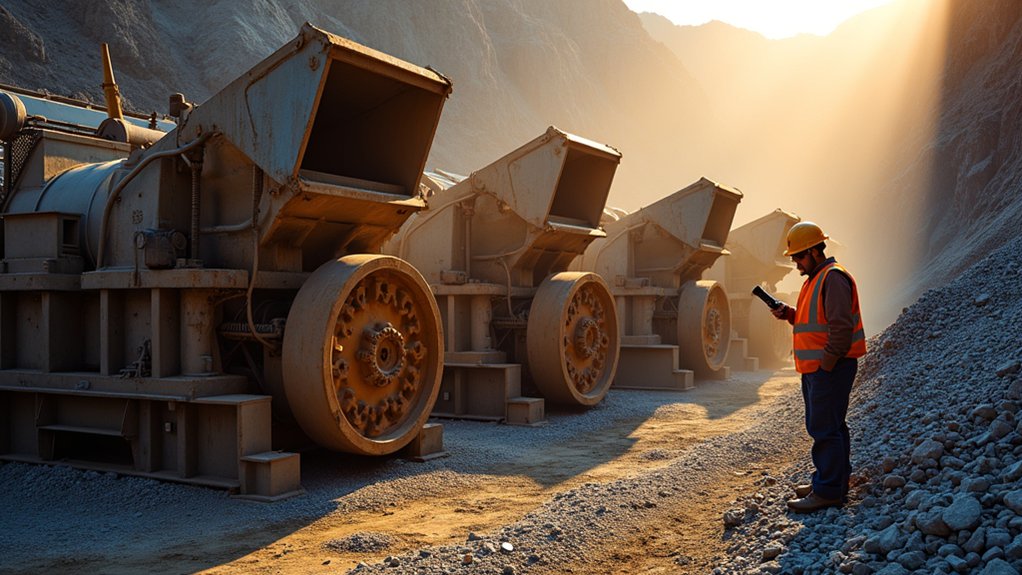
Because crusher performance hinges on rock type, throughput targets, and site constraints, you should choose a heavy-duty quarry crusher brand by quantifying your duty cycle first: feed size and abrasiveness (e.g., granite vs. limestone), required product gradation, tph at P80, uptime/availability targets, and total cost of ownership (wear parts $/ton, kWh/ton, planned maintenance hours).
Next, compare brands using verifiable field metrics: installed base in similar geology, liner life distributions, and power draw at matched reduction ratios.
Validate Brand reputation with references, not brochures, and request maintenance logs from comparable sites.
Audit after sales support: local parts inventory, technician response SLA, remote diagnostics, and training.
Finally, score commercial risk—warranty clarity, lead times, and spares pricing—then pick the brand that minimizes $/ton while meeting your availability target.
Metso Heavy-Duty Quarry Crushers: Uptime and Wear Life
If you’re optimizing a quarry for availability, Metso’s heavy-duty crushers stand out where uptime and wear life drive total $/ton, not just nameplate tph. You’ll typically see designs focused on stable power draw, rigid frames, and high-inertia rotors or cones that protect crusher durability under abrasive feeds.
To extend liner life, you can run tighter CSS control, maintain choke feeding, and track wear with routine measurements so you don’t overrun profiles.
You’ll cut unplanned stops by standardizing maintenance strategies: plan changeouts around tonnage, keep critical spares staged, and use condition monitoring for bearings, lube temperature, and vibration.
When you align metallurgy to rock competency and enforce correct lubrication, you can push longer intervals between relines while keeping product shape consistent and throughput predictable.
Sandvik Heavy-Duty Quarry Crushers: Modular Capacity at Scale
When you need to scale quarry output without redesigning the whole plant, Sandvik’s heavy-duty crushers and modular station concepts let you add capacity in repeatable blocks while keeping uptime predictable.
You can standardize steelwork, power, and controls, then plug in extra crushing stages as tonnage grows, reducing engineering hours and commissioning risk.
With crusher customization, you’ll tune chamber geometry, eccentric throw, and liner profiles to match feed size and abrasion, protecting throughput while tightening product curves.
You’ll also align automation setpoints with real-time amps and hydraulic pressure to prevent stalls.
For maintenance strategies, you’ll plan liner swaps around measured wear, use quick-lift tooling, and keep spare cassettes staged, cutting changeout time and stabilizing cost per ton.
Predictable availability follows.

Terex Finlay/Powerscreen Quarry Crushers: Tracked Mobility
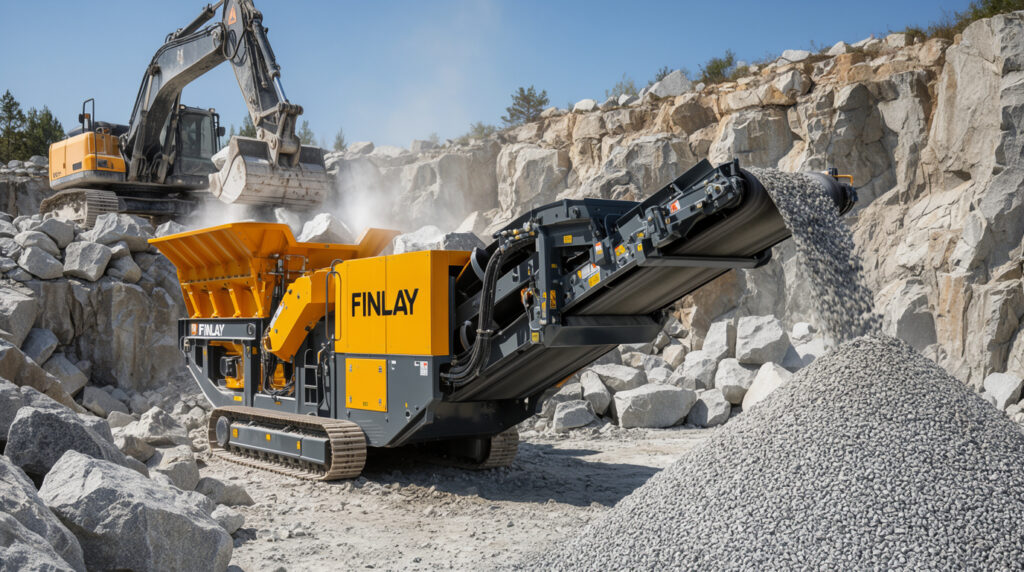
Sandvik’s modular stations scale output in fixed blocks; Terex Finlay and Powerscreen scale output by moving the crusher to the rock. You cut haul distance with tracked jaws, cones, and impactors that reposition in minutes, not hours, keeping the face-fed circuit tight as the bench advances.
With 500–1,200 tph class configurations (model-dependent), you can match crusher to shot size and swap screens or stackers to hold spec without rebuilding pad infrastructure.
Tracked mobility also trims civil works and truck idle time, supporting Eco friendly innovation through lower diesel burn per tonne moved.
You’ll value customer support when you’re redeploying often: parts availability, field service, and application guidance keep uptime predictable across multi-pit, multi-product schedules.
Kleemann Wirtgen Quarry Crushers: Automation and Fuel Control
Although tracked mobility shortens haul cycles, Kleemann’s Wirtgen Group crushers push efficiency further by using automation and fuel control to stabilize throughput at the lowest possible kWh per tonne. You’ll tune CSS, feeder speed, and engine load via automation integration, keeping the chamber consistently choked and minimizing recirculation. Load-sensing hydraulics and intelligent engine speed reduction cut idle burn, so you preserve fuel efficiency without sacrificing tph. Use telematics trends to set alarms for rising amps, belt slip, or liner wear, then schedule stops before production drops.
| Control focus | Practical gain |
|---|---|
| Auto CSS/feeder control | Steadier 0–32 mm output |
| Engine RPM management | Lower L/h at partial load |
| Condition monitoring | Fewer unplanned shutdowns |
Frequently Asked Questions
What Warranty Terms and Extended Service Plans Do Top Brands Offer in 2026?
You’ll typically get 12–24 months Warranty coverage on major components, with exclusions for wear parts. You can buy Extended service plans to 3–5 years, bundling inspections, OEM parts, priority labor, and uptime guarantees.
How Do Crusher Brands Compare on Total Cost of Ownership Over Five Years?
Energy can hit 30–50% of five-year TCO, so you compare brands by kWh/ton, wear-part life, uptime, and service logistics. Advanced crusher technology cuts operating costs, while strong brand reputation lowers financing and resale risk.
Which Brands Have the Fastest Spare-Parts Availability in My Region?
You’ll get the fastest Regional spare parts from brands running local depots and OEM-authorized distributors in your region. Validate lead times, fill rates, and critical SKU coverage; brand reputation should track documented service-level performance and backorder frequency.
Do These Crushers Meet 2026 Noise, Dust, and Emissions Compliance Requirements?
You can’t assume full 2026 compliance; you must verify certified noise, dust, and emissions test data for each model. Ask for Environmental impact reports and technological innovations specs, plus local permits and aftertreatment documentation.
What Financing, Leasing, or Buyback Programs Are Available for Quarry Operators?
You’ll find Financing options like equipment loans, revolving credit, and OEM-backed rates; Leasing programs include operating or finance leases with $1 buyouts. Many dealers offer guaranteed residuals, trade-ins, and buybacks tied to hours, condition, and maintenance.
Conclusion
You’re not just buying iron—you’re buying uptime. A common theory says the “best crusher” is the one with the highest peak tph, but site data often disproves it: net tons shipped track availability, wear life, and changeover time. If you do your research and validate OEE, liner consumption per ton, kWh/ton, and move/setup hours, the winner becomes obvious. Metso, Sandvik, Terex Finlay/Powerscreen, Kleemann, and TON each optimize different constraints—match the brand to your bottleneck.