

You probably don’t know that the break-even point between mobile crushers vs. stationary crushing often swings by 20–40% just from haul distance, grid access, and permit timelines. If you’re running variable faces, short mine life, or uncertain geology, mobile CAPEX and civil scope can beat a fixed plant even with higher fuel burn. But if your feed is stable and throughput is steady, stationary OPEX per ton usually wins. The key is where your tons and risks actually sit…
Key Takeaways
- Mobile crushers win when haul distances exceed 1.5–2.0 km, benches shift often, or ROM pockets are short-lived and variable.
- Stationary plants win with steady throughput and long mine life, where civil, power, and permitting costs amortize into lower $/ton.
- Compare total cost per ton using real uptime inputs: shift patterns, MTBF/MTTR, wear-part intervals, spares logistics, and planned maintenance windows.
- Model energy costs explicitly: grid typically 8–14 kWh/ton, diesel about 0.7–1.2 L/ton, with idling and voltage stability affecting efficiency.
- ROI should use NPV/payback and break-even tons, incorporating move frequency, peak tph, environmental compliance costs, and truck/loader cycle savings.
Mobile vs Stationary Crushing Plants: Decision Inputs
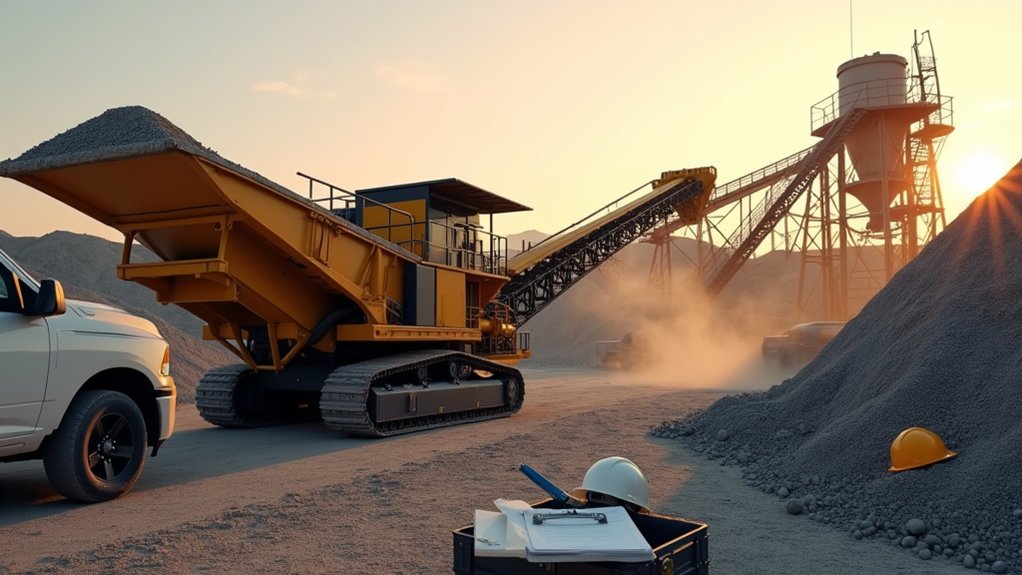
If you start with the site constraints and the production target, you’ll usually see quickly whether a mobile train or a stationary plant fits better.
Quantify ROM variability, target gradation, and peak tph, then map them to crusher type, screen area, and surge capacity.
Check haul distances, bench geometry, and tipping points that drive loader hours and fuel burn.
Model uptime using shift patterns, maintenance windows, and spares logistics, not brochure availability.
Validate power: grid access, genset sizing, and voltage stability directly affect kWh/ton and liner life.
For Technology integration, confirm PLC/SCADA compatibility, telemetry coverage, and automated sampling for closed-loop control.
For Environmental impact, calculate dust capture needs, water balance, and noise limits against permit boundaries and community receptors.
Quick Fit Check: When Mobile Beats Stationary
When your face-to-plant haul road stretches, benches shift week to week, or ROM comes in uneven, mobile crushing usually wins on total cost by cutting truck hours, diesel burn, and rehandle.
You’ll see the advantage when average one-way haul exceeds 1.5–2.0 km, elevation changes force low truck speeds, or you’re chasing multiple short-lived pockets.
If your ore/waste ratio swings daily, a mobile train lets you relocate to keep crusher feed steady and reduce dilution.
You also fit mobile when permits constrain permanent civils, or when schedule risk makes phased deployment valuable.
Track your KPIs: truck queue time, crusher utilization, and stockpile turnovers.
Market trends favor flexible assets, and the environmental impact drops as haul kilometers and dust sources decline overall.
Mobile Crusher Costs: CAPEX, Fuel, Labor, Downtime
You’ll start by itemizing mobile crusher CAPEX on your site—crusher and screen packages, onboard genset or grid tie-in, stackers, mobility kit, and freight/commissioning—then normalize it to $/t over your planned move frequency and mine life.
Next, you’ll model OPEX with measured diesel burn (L/h at target throughput), operator and maintenance headcount per shift, and support equipment hours for feeding and relocation.
Finally, you’ll quantify downtime with your actual MTBF/MTTR, wear-part change intervals, and planned maintenance windows so you can convert lost hours into lost tons and a $/t penalty.
Upfront CAPEX Breakdown
Although mobile crushers can lower civil works and permitting scope, your upfront CAPEX still concentrates in a few site-specific line items: the crusher and screen train (often the largest purchase), tracked chassis and power pack, onboard or modular conveyors, and commissioning/spares packages sized to your rock hardness and target throughput.
Specify duty cycle and gradation, then price options against availability, lead time, and Environmental impact constraints.
- Primary unit type (jaw/impact/cone), chamber liners, and screen decks for abrasion index and feed PSD
- Mobility package: track frames, hydraulic circuits, and onboard generator vs. external power tie-in
- Material handling: conveyor lengths, stacker height, magnet, and dust suppression modules
- Startup scope: commissioning days, critical spares list, and Supply chain risk buffers
Fuel And Labor Costs
A mobile crusher’s operating cost usually hinges on two variables you can measure quickly on-site: diesel burn per processed tonne and labor hours per shift to keep the train fed, moving, and maintained.
Track L/hr at steady-state and convert to L/t using belt scale tonnage; your haul distances, rock abrasivity, and elevation changes shift that curve fast. If you’re idling to wait on trucks or a loader, fuel per tonne spikes.
Labor scales with system complexity: one operator plus a loader may work on a tight footprint, but adding a screener, stacker, or rehandle point can require another headcount or longer shifts.
Factor Environmental impact and community considerations: higher burn raises CO₂ and noise, so you may need lower-RPM operating windows or rerouted traffic.
Downtime And Maintenance Impact
When your mobile crusher train stops, cost per tonne climbs immediately because fixed ownership and crew time keep ticking while output hits zero. Track downtime by component and location; a two-hour unplanned stop on a 250 tph spread can erase 500 tonnes of revenue and add rehandle costs.
- Plan liner and screen media changeouts around blast cycles to protect equipment durability.
- Stock critical spares (hydraulics, belts, idlers) at the face to cut MTTR.
- Use oil analysis and vibration trends to predict bearing and gearbox failures.
- Standardize lockout and quick-coupler procedures to speed safe field service.
Your advantage is operational flexibility: you can relocate to reduce haul, but only if maintenance keeps availability above ~85% and delays below 3%.

Stationary Crushing Plant Costs: Civil Works, Power, Permits
Because a stationary crushing plant stays put for years, you’ll pay upfront for the site to behave like industrial infrastructure: engineered earthworks and foundations sized for dynamic loads, permanent power distribution (MV/LV service, transformers, MCC/VFD rooms, cable trenches), and a permitting package that satisfies zoning, noise, dust, stormwater, and traffic requirements.
You’ll budget geotech drilling, compaction specs, and reinforced pads for crushers, screens, and conveyors; weak subgrade or high groundwater forces over-excavation, drains, and thicker concrete. You’ll also fund substation upgrades, demand charges, and harmonic/starting-current studies to prevent nuisance trips.
Permits hinge on Environmental impact modeling: PM10/PM2.5 dispersion, noise contours, and runoff sampling plans. If you’re near receptors or sensitive habitats, mitigation adds enclosures, baghouses, and haul-road paving, reducing Market flexibility.
TCO Comparison: Mobile vs Stationary (Per Ton)
Although headline purchase price gets the attention, your per‑ton total cost of ownership (TCO) hinges on utilization, moves, and energy.
Stationary plants usually win at high, steady throughput on a fixed bench (lower kWh/ton, lower wear per ton, fewer relocations), while mobile spreads capital across multiple faces but pays in diesel (or genset) fuel/ton, transport/rigging time, and higher wear from variable feed and frequent starts/stops.
- Track energy: 8–14 kWh/ton grid vs 0.7–1.2 L diesel/ton plus idling.
- Price wear: liners, belts, and bearings spike with abrasive feed and tramp metal.
- Count moves: each relocation adds crew hours, permits, and lost production tonnage.
- Quantify Environmental impact: CO₂/ton, dust, noise, and spill risk.
With Technological advancements (VFDs, hybrid drives, telemetry), you’ll tighten utilization, but your site’s haul distance and power tariff decide. Research is the key here.
ROI Calculator: Payback, NPV, Break-Even Tons
To size ROI for mobile crushers vs. stationary plants, you’ll estimate payback by mapping your site’s capex, operating cost delta ($/t), utilization hours, and forecasted tonnage against monthly cash flow.
You’ll then calculate NPV using your discount rate, project life, and salvage value, with scenario bands for fuel, labor, and uptime to quantify risk.
Finally, you’ll compute break-even tons where cumulative discounted savings equal the initial outlay, giving you a tonnage threshold you can validate against your pit plan and production schedule.
Payback Period Estimation
A clean payback estimate for a mobile crusher versus a stationary plant starts with your site’s actual cash flows per ton—sale price, feed variability, uptime, diesel or kWh, wear parts, labor, and haul distance—not brochure specs.
Build a monthly model: CapEx delta ÷ incremental net margin = payback months.
You’ll tighten inputs by logging production hours, unplanned stops, and product yield by gradation.
Include Environmental impact costs you actually face (dust suppression, permitting, carbon fees) and credit measurable savings from shorter haul cycles.
Technological advancements matter only if they lift availability or cut unit energy.
Track payback sensitivity with four levers:
- Net margin/ton ($/t)
- Throughput (t/hr) × utilization (%)
- Variable OPEX/ton (fuel, wear, labor)
- Mobilization, install, and rehandle costs
NPV And Break-Even Tons
How do you decide whether mobility really beats concrete and steel once you price in time and risk? You’ll model NPV by discounting site cash flows: savings from haul distance cuts, crew hours, fuel, and avoided permits, minus relocation downtime and maintenance spikes. Set your discount rate to your weighted cost of capital, then solve break-even tons where cumulative discounted margin equals capex.
| Metric | Mobile Crusher | Stationary Plant |
|---|---|---|
| Discount rate | 10% | 10% |
| NPV @ 250k t/yr | +$0.6M | +$0.2M |
| Break-even tons | 410k | 690k |
| Environmental impact, regulatory compliance | Lower diesel-hours; fewer truck miles | More fixed permits; longer EIA path |
If regulators tighten, you’ll value optionality: mobility derisks schedule.
Frequently Asked Questions
What Warranties and Service Contracts Are Typical for Mobile and Stationary Crushers?
You’ll typically get 12–24-month warranties on frames, powertrains, and major components, plus optional service contracts covering parts, labor, and telematics. You’ll lock Maintenance schedules, and guarantee compliance-driven inspections for Environmental regulations, emissions, dust, noise.
How Do Resale Values Compare for Used Mobile Crushers Versus Stationary Plant Equipment?
You’ll usually get higher resale values from used mobile crushers; their resale market stays liquid despite faster depreciation rates. Think “pickup vs poured slab”: I’ve seen a 3‑year jaw unit retain 55% near quarries.
What Insurance Requirements Differ Between Mobile Crushing Units and Fixed Plants?
You’ll insure mobile units with auto/marine transit Insurance policies, on-road compliance, and moving-equipment Liability coverage for haul routes. You’ll insure fixed plants with property, business interruption, and premises Liability coverage tied to site hazards.
How Do Financing and Leasing Options Affect Cash Flow for Each Setup?
You’ll smooth cash flow with lease options on mobile units, matching payments to site moves and tonnage. You’ll strain cash flow financing fixed plants, facing higher down payments, longer terms, and delayed revenue until commissioning.
What Cybersecurity or Automation Integration Risks Come With Modern Crusher Control Systems?
A chain’s only as strong as its weakest link: you’ll face Cybersecurity vulnerabilities via exposed PLC/HMI ports, weak VPNs, and stale firmware; plus automation integration risks from OPC UA mismatch, latency, and unsafe interlock mapping.
Conclusion
If you pick the wrong crusher setup, you’ll hemorrhage margin by the truckload. For short mine lives, shifting faces, or long haul distances, you can slash civils to near-zero and start producing fast with mobile—then redeploy before your payback even blinks. But if you’ve got stable feed and 24/7 tonnage, stationary wins on kWh/ton, wear/ton, and $/ton once permits and concrete amortize. Run break-even tons, NPV, and mobilization risk per site.