
- Key Takeaways
- How Quarry Crushers Work
- Types of Quarry Crushers
- The Crushing Stages
- Key Performance Factors
- Beyond The Steel
- Crusher Safety and Maintenance
- Conclusion
- Frequently Asked Questions
- How does a quarry crusher work?
- What are the main types of quarry crushers?
- What are the typical crushing stages in a quarry?
- What factors affect a quarry crusher’s performance?
- How important is maintenance for quarry crushers?
- What safety practices are essential when operating a quarry crusher?
- How does automation improve quarry crusher performance?
Key Takeaways
- Quarry crushers break large rocks into smaller, usable sizes by applying mechanical forces in a controlled sequence that includes feeding, force application, rock fracture, size reduction, and discharge. Knowing this process flow helps operators select the appropriate equipment and configure the plant for steady-state efficient production.
- Various crusher types including jaw, cone, gyratory, impact, and VSI machines use compression or impact mechanisms that match rock hardness, abrasiveness, and target product shape. By matching crusher type to material properties and target output size, you can optimize product quality and avoid unnecessary wear and downtime.
- Staged crushing with primary, secondary, and tertiary crushers provides progressive size reduction and shaping that results in well-graded aggregates suitable for concrete, asphalt, and other construction applications. By adjusting the reduction ratios and capacities at each stage, the plant operates efficiently and avoids bottlenecks.
- Key performance depends on material properties, machine settings and operational control, which all need to be monitored and adjusted with data such as throughput, power draw and wear rates. Operators can maximize efficiency by tuning closed side settings, feed rates and speed and recording adjustments to achieve consistent, repeatable results.
- More than mechanical design, things like energy consumption, wear and tear, and automation all strongly influence total operating cost and sustainability. Energy-efficient practices, wear-resistant parts, and monitoring systems can help increase uptime, extend component life, and reduce environmental impact.
- Good safety and maintenance programs with checklists, scheduled inspections, preventative parts replacement and comprehensive operator training are a must for dependable, safe crusher operation. Regular lockout and tagout, regulatory and manufacturer guidance safeguard individuals, machinery and general efficiency.
===
A quarry crusher works by breaking large rocks from the pit into smaller, uniform sizes using strong mechanical force and controlled pressure.
Generally, raw stone feeds into the crusher chamber, where moving and fixed surfaces crush it in stages. Various crusher types, such as jaw, cone, and impact, process certain size ranges and hardness levels.
To provide context, the following sections explain each phase and mechanical component.
How Quarry Crushers Work
Quarry crushers reduce this rock to consistent sizes that downstream plants either screen, wash, or blend into construction aggregates, railway ballast, or mineral feed. They accomplish this by exerting mechanical force, predominantly compression or impact, over multiple stages: primary, secondary, and tertiary. Each stage drives the material toward a finer, more controlled gradation suitable to design specifications for strength and workability.
1. Material Feed
Material typically comes from a haul truck or wheel loader into a feed hopper, then onto a conveyor that feeds rock at a measured rate into the crusher chamber. A steady metered flow is critical because the crusher is engineered to work best with a partly filled chamber, not with empty surges or sudden overloads.
Feed size is as important as feed rate. If you feed boulders that are too large for the entrance, you risk bridging, where stones form an arch over the chamber and obstruct it. That results in emergency halts, manual removal, and hazard danger, all of which eat away at production.
Upstream scalping screens or grizzly bars eliminate fine soil, clay, and undersized rock prior to reaching the crusher. They can throw out very large, out-of-spec chunks that should be busted with a rock breaker first.
About how quarry crushers work, a properly set up plant keeps the crusher around 70 to 85 percent choke fed, so the chamber remains mostly full. This layer helps stabilize power draw, improves reduction, and distributes wear more evenly across liners, extending service life.
2. Force Application
Crushers pulverize rocks by squeezing or banging them between two surfaces. In compression machines, such as jaw and cone crushers, surfaces come together and crush the material. In impact machines, fast moving hammers or blow bars smash the rock and fling it against impact plates.
In a jaw crusher, a moving jaw swings toward a stationary jaw with each stroke, crushing rock caught between the plates, which falls by gravity to a narrower gap until it reaches discharge size. In a cone crusher, a rotating mantle moves eccentrically inside a stationary concave, repeatedly pinching the rock as it descends through the chamber.
This force’s magnitude, angle, and orientation determine the shape of the product. Compression typically provides more cubical, controlled particles, while impact can create finer material but more flaky pieces.
Matching the force method to the rock type, hardness, and desired product is a key design choice when you select between jaw, cone, or impact units for each crushing stage.
3. Rock Fracture
When this stress is greater than the strength of the rock, it breaks along natural planes of weakness such as grain boundaries or tiny cracks. For compression crushers, this typically implies the rock is compressed and splits and cleaves as it travels through the constricting gap.
Impact crushers utilize fast blows to break rock, causing numerous fractures in a very short time. This works well for brittle materials, but does not work as effectively with hard, ductile rocks that instead absorb energy rather than fracture.
How well fracture occurs depends on brittleness, hardness, and moisture. Very hard or wet rock, for example, may resist breakage or pack together, reducing throughput and making operators adjust settings or moisture control.
When fracture is efficient, you have a consistent particle size distribution and a dependable reduction ratio from feed to product size. This enables straightforward downstream screening and blending.
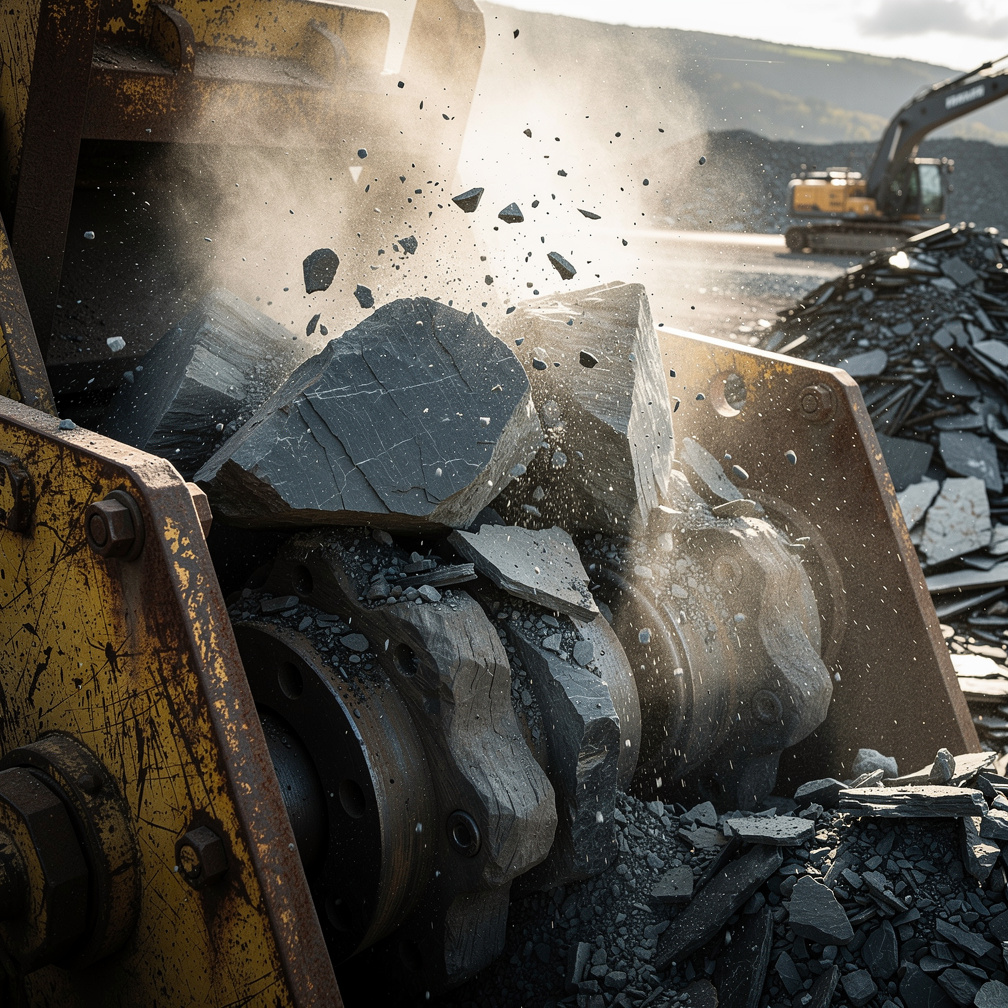
4. Size Reduction
Size reduction is the core job: turn big, mined rock into smaller pieces that meet a target top size or gradation band. The reduction ratio, which is the feed size divided by the product size, is a big factor, and it varies by stage. Primary jaws knock large boulders down to, say, 150 to 300 mm, while secondary and tertiary cones ram it into fine aggregate ranges.
Most quarries run multiple stages: a jaw for primary, one or more cones for secondary and tertiary, sometimes followed by an impact crusher if they need sharper shape for asphalt or concrete sand. Each stage cuts the maximum size window and controls fines even more.
Control of reduction in our experience leads to improved downstream efficiency. Screens sort fractions more cleanly, conveyors hum more smoothly, and final stockpiles hit spec without heavy rework or recirculation.
5. Material Discharge
Once crushed, material leaves through a designated discharge opening or slot at the bottom of the chamber, falling onto a takeaway conveyor or chute. This discharge gap, known as the closed-side setting in jaws and cones, directly governs the nominal product size.
Others utilize supplementary screens and flexible curtains to dial in discharge size. Once the discharge path is open and properly calibrated, material flows uninterrupted, which safeguards against chamber build-up, power spikes, and stalls.
Overfeeding clogs this discharge area, drives up wear on liners, mantles, and toggle plates and forces shutdowns. Plants employ feed control, level sensors and preventive maintenance, such as timely replacement of liners, mantles, and other wear parts, to keep discharge smooth and predictable through all stages.
Types of Quarry Crushers
Quarry crushers come in a few main families, each centered around a different method of rock crushing. Each is designed to slice big, ragged chunks down to manageable sizes that screens can separate into marketable merchandise.
- Jaw crusher, compression between a fixed and a moving jaw.
- Cone crusher – compression in a narrowing cone-shaped chamber.
- Gyratory crusher is a compression type that features a large oscillating mantle within a wide shell.
- Horizontal shaft impactor (HSI) is a high-speed rotor that throws rock against impact plates.
- Vertical shaft impactor (VSI) – rotor hurling rock against anvils or rock bed.
- Hammer crusher / hammer mill – rotating hammers delivering repeated impacts.
Each type leans on one main reduction mode: compression, impact, or shearing, and the best fit depends on material hardness, feed size, target output size, reduction ratio, and the wear and energy profile a site can support. When these are matched well, the crusher works in step with screeners that sort output into standard sizes, like 20 mm base, drainage stone, and fines, with much less bottlenecks in the plant.
Knowing them helps you read a process flow sheet, choose the right gear for a quarry or mining job, and anticipate how a change in rock or product spec will ripple through capacity, shape, and wear.
Compression Crushers
Compression crushers decrease size by compressing rock between two rigid surfaces until it breaks, which produces preferential breakage along natural planes rather than indiscriminate shattering. Jaw, cone, and gyratory crushers are the principal members of this group and account for virtually all of the primary and much of the secondary and tertiary stages in hard rock quarries.
Jaw crushers consist of a fixed jaw and a moving jaw which together form a V-shaped chamber. The rock is compressed as the movable jaw swings against the fixed jaw. They are common at the primary stage for medium-hard to hard materials.
Gyratory crushers operate on the same principle of compression, but at a larger scale, with a tall conical mantle moving within a corresponding concave shell to accommodate very large feed sizes in high-capacity primary stations. Cone crushers extend the concept to secondary and tertiary stages, employing a cone-shaped head lowered toward a bowl liner so rock is crushed in a narrowing gap.
This aids both fine control of product size and good shape control for aggregates. These machines work well with hard rock, granite, and other abrasive materials because the compressive force is high, consistent, and transmits through the rock instead of depending on impact blows on the surface. This results in steady reduction ratios and dependable, consistent product curves.
Impact Crushers
Impact crushers pulverize material with quick, powerful blows from hammers or impact plates, so rock fails primarily in tension rather than compression. This often leaves a more cubical, sharp-edged product that mixes well in concrete and asphalt. The primary types are horizontal shaft impactors (HSI), vertical shaft impactors (VSI), and hammer crushers or hammer mills.
All are constructed around a high-speed rotor that throws material outward. HSI units use a horizontal rotor that hurls rock against breaker plates that can be adjusted and are thus useful as primary or secondary machines on softer to medium-hard stone and in recycling streams such as concrete and asphalt.
VSI crushers turn the shaft vertical, spin a rotor at high speed, and sling rock against anvils or a rock-lined chamber, which makes them a match for tertiary duties where you’re concerned about fine aggregate and clean, consistent shape. Hammer mills and hammer crushers utilize sets of swinging hammers to strike and shear material and can operate as primary, secondary, or tertiary crushers, providing operators flexibility when feed characteristics vary.
Impact crushers suit softer rocks, many sedimentary deposits, and mixed feeds from demolition as they provide high reduction ratios in one pass and handle variable particle shapes. Quarry and mining – HSIs and VSIs typically sit downstream of a compression crusher, refining product shape. Screeners divide the flow into final spec sizes for base layers, drainage, and sand manufacturing.
The Crushing Stages
Quarry crushing is on a staged path. Each of these stages employs a different crusher type to reduce rock size stepwise, from blocks in excess of 1,000 mm down to fine aggregates less than 10 mm. That staged layout controls power consumption, safeguards machinery and produces well-graded concrete, asphalt and railroad ballast products.
-
Primary crushing reduces run-of-quarry rock to manageable pieces.
-
Secondary crushing trims these chunks into controlled, intermediate sizes.
-
Tertiary crushing sculpts and granulates to close specifications.
-
Some plants include a quaternary stage for very fine or specialty products.
At each of these crushing stages, the plant team needs to match crusher type, capacity and reduction ratio to feed size and target product. A typical cone crusher reduction in secondary and tertiary stages ranges from about six to four, so the output of one stage must “fit” the inlet of the next. Well executed staged crushing provides high throughput, steady power draw, and a stable grading curve – exactly what downstream consumers want.
Primary Stage
Primary crushers, typically jaw or gyratory units, sit near the quarry face and take the initial size reduction. They use big, raw rock right off blasting, sometimes lumpy or with pockets of clay or steel pieces from drilling. The idea is not to make finished products here, but simply to reduce the size to where conveyors, screens, and downstream crushers can operate in a steady, reliable manner.
A good primary keeps the entire plant in harmony because it determines both the top size and the tonnage flow for the remainder of the circuit. These machines emphasize robustness and throughput. One primary jaw can crush several hundred tonnes per hour, sometimes over 1,000 tonnes per hour, depending on rock hardness and feed opening.
Frames are thick steel or cast, bearings are oversized and the crushing chamber is designed to take variable feed without blockage. For mobile plants, the same principle applies. The crusher is mounted on tracks or wheels so that it can follow the mining face and reduce haul distances.
Secondary Stage
Following primary crushing, material falls to the secondary stage, where cone or impact crushers further reduce rock to intermediate sizes, typically in the 25 to 100 mm range. Now the feed is cleaner, more uniform, and screened for fines. Secondary cones commonly run with reduction ratios near 6 to 1, while some impact crushers can push that a bit higher on softer stone.
Choice of secondary crusher ties back to the rock type and the downstream targets. Hard, abrasive granite tends to favor cone crushers, which sacrifice steady compression action for lower wear cost. Softer or less abrasive limestone could employ impact crushers when the plant desires a more cubical particle for asphalt.
Fine secondary crushing helps to control size more precisely, reduce recirculating load and increase both overall plant productivity and product consistency.
Tertiary Stage
Tertiary crushers process the last reduction and shaping before stockpiles and they often determine if a quarry can meet tight concrete or asphalt specs without expensive reprocessing. Usual tertiary machines are short-head cone crushers, VSI, and some specialized impact units, occasionally supplemented by a quaternary cone if market demands very fine sands.
Standard cone crushers have taller chambers and generally provide coarser products around 25 to 100 mm. Short-head cones feature a shorter, steeper chamber designed for finer product between approximately 6 and 25 mm, well-suited to typical fine aggregate ranges.
In many plants, both tertiary and quaternary stages run cone crushers in closed circuit with sizing screens, dialing in reduction ratios around 4 to 6 to hit a narrow gradation envelope. Where shape is paramount, like high-performance concrete or some asphalt mixes, VSIs come into the line to enhance angularity and surface texture.
Whether the plant is portable or fixed, the tertiary setup is tailored to local market requirements, weighing fuel consumption, wear expense and end users’ quality requirements.
Key Performance Factors
Crusher performance rests on three pillars: what you feed into the machine, how the machine is set, and how people and systems run it day to day. Getting these factors right drives throughput, product quality, and wear life, which all drive the economics of a quarry.
Material Properties
Material characteristics dictate the boundaries for what most any crusher can accomplish. Hardness, abrasiveness, moisture, and feed size all alter the way the crusher operates, even if you maintain the same model and power rating. A jaw crusher crushing soft limestone at 150 mm feed will behave entirely different than the same unit handling a hard, abrasive granite at 400 mm feed, even if the discharge size requirements are comparable.
Hard or highly abrasive rock requires a more robust crusher frame and premium-grade wear parts. Wear-resistant liners, mantles, and toggle plates in the right alloy mix decelerate wear and maintain the reduction ratio over time. If you discount this and rage abrasive material on light-duty parts, you might make your near-term tonnage goal but suffer for it with constant liner replacements, expensive operating costs, and erratic product.
Moisture is another silent assassin. Sticky or wet material packs in the chamber, bridges at the inlet, and choke screens so operators need pre-screening, washing, or special feed arrangements to prevent choking. Fines removal prior to crushing can assist greatly when feed is both wet and dirty.
When the crusher type matches the material, proper feed size range, proper hardness window, and proper reduction ratio, the machine spends more time crushing and less time down cleaning or unplanned maintenance. That drop in downtime, along with longer wear-part life, frequently counts for more in profits than a little increase in nameplate capacity.
Machine Settings
Machine settings are where operators directly control product size and throughput. The closed-side setting (CSS), speed, and feed rate work together to define the reduction ratio, which is usually calculated as the feed size passing 80% (F80) divided by the product size passing 80% (P80). Two plants with the same crusher make can yield very different results if they operate with different CSS, jaw profiles, and feed gradations under different material conditions.
CSS is particularly critical in jaw crushers as it helps define the nip angle in the chamber, generally in the 19 to 23 degree range. If the angle is too wide, you lose grip and observe suboptimal breakage. If the angle is too tight, you increase power draw, risk stalls, and strain the machine. CSS modifications modify the reduction ratio and fines share in the output; therefore, every adjustment has an immediate product quality effect.
Improper settings manifest as strange wear patterns, flaky product, or low yield. For example, thrusting for high reduction in one pass by incorporating a third chamber or running extremely tight settings may increase reduction, but it inflates power requirements and typically amps up wear expense. Recording setting changes, whether with rudimentary logs or sophisticated digital tools, provides operators a shortcut back to “known good” setups when the blend or target product shifts.
Operational Control
Operational control connects the physics of the rock and the mechanics of the crusher into a stable, repeatable process. Expert operators monitor feeder load, power draw, and product shape, then adjust feed rate or CSS prior to issues becoming trips or blockages. Many capacity complaints start with the feed system, not the crusher itself. Poorly regulated feeders, surging trucks, or uneven distribution across the chamber can all cut effective capacity even when the nameplate rating looks fine.
Modern plants rely on automation and remote control to keep the crusher in its sweet spot. Control systems can maintain a target power draw, automatically adjust CSS, and alarm on abnormal vibration or temperature, all of which contribute to longer wear-part life and a more consistent reduction ratio. The data from throughput, power usage, and wear measurements form a historical record that planning teams can utilize to select better liner designs or determine smarter preventative maintenance schedules.
Standard operating procedures—start-up, shutdown, blocked-chamber clearing, inspection routines—keep the operation safe and steady. Paired with preventive maintenance like timely replacement of mantles, toggle plates, and liners, these routines reduce unplanned stops and preserve both operating costs and wear part longevity, which are central factors of long-term profitability in any quarry.
Beyond The Steel
Quarry crushers do more than crush rock. Day to day, their worth derives from how efficiently they consume energy, how quickly they erode, how easily they interface with the remainder of the plant, and how shrewdly they operate across primary, secondary, and tertiary stages.
Energy Consumption
Energy use is the heart of total operating cost, particularly when powering big compression machines that press rock between two plates in a slow, high-force motion. Primary and secondary crushers pull consistent power for extended periods. Tertiary crushing in mineral processing deposits an additional level of requirement as it forms finer, more exact products.
Good practice regards every kilowatt-hour as a cost signal, not a static burden. Key strategies for energy efficiency include:
- Match crusher type to feed size, hardness, and desired product.
- Run compression crushers in the 70–85% choke-fed range.
- Avoid overfeeding that causes jams, recirculation, and wasted power.
- Use variable-speed drives on feeders and conveyors.
- Keep liners wear parts in shape for nip angle.
- Optimize reduction ratio across primary, secondary, and tertiary stages.
- Utilize real-time power and throughput monitoring to fine-tune settings.
- Automate start/stop sequences to cut idle running time.
Energy-efficient designs along with stable choke feeding and clean feed flow to and from screens and conveyors lower cost per tonne and reduce the plant’s overall footprint. A basic table contrasting kWh per tonne for jaw versus cone versus impact versus HPGR under equivalent feed conditions can steer equipment selection prior to any CAPEX investment.
Wear and Tear
Wear on parts is as significant as nameplate capacity. Rock hardness, feed size, and crusher type all alter how quickly parts wear. Compression units are excellent for hard, abrasive stone, but mantles, liners, and toggle plates still get consumed.
Impact crushers may wear quicker when the feed is sharp and silica-rich. With different impact angles and load cycles occurring at each crushing stage — primary, secondary, and tertiary — service life varies across the line.
|
Component |
Typical Role |
Indicative Service Life* |
|---|---|---|
|
Jaw dies |
Primary compression |
4–12 weeks |
|
Cone mantle |
Secondary/tertiary |
6–16 weeks |
|
Bowl/concave |
Secondary/tertiary |
6–16 weeks |
|
Impact blow bar |
Secondary |
1–8 weeks |
|
Screen media |
Classification |
2–10 weeks |
*Ranges depend on material hardness, degree of choke, and quality of maintenance.
Regular inspection and preventive maintenance keep output stable and predictable. Swapping mantles, liners and toggle plates before they fail protects your chamber profile, preserves your reduction ratio and limits unplanned downtime.
Much of the site uses wear-resistant alloys and OEM parts as the premium purchase price is often repaid in longer runs, better particle shape and fewer shutdowns, particularly in high-value tertiary circuits where fine gradations and narrow-size bands make a difference.
Automation’s Role
Automation weaves together all these strands — energy, wear, output quality — into a single control level. Modern systems read sensor data from power meters, level probes, vibration monitors and belt scales and then adjust closed side settings, feeder speed and sometimes cavity selection in real time.
Once a cone, for instance, is choke fed at 70 to 85 percent chamber fill, the system maintains consistent product size and shape and protects the crusher from shock loads associated with overfeeding and sudden blockages.
From a safety and staffing perspective, automation reduces the need for workers to stand next to moving parts to adjust settings or dislodge small blockages. That counts in an area with rigorous safety regulations.
Operators can observe trends from a control room or remotely, and instead concentrate on higher-level tasks like planning liner changes, balancing load across primary, secondary, and tertiary stages, and tuning the circuit for a given end product.
Automated diagnostics, like abnormal power draw or sudden vibration spikes, warn ahead of a bearing failure or liner breakaway. This minimizes unplanned downtime and allows maintenance to be scheduled around production goals instead of vice versa.
When crushers plug into plant-wide control and share data with conveyors, screens, and stockpile systems, the entire flow gets easier to balance. The system can throttle upstream feed when the tertiary section approaches its capacity or open the circuit when an emergency coarse product order arrives, preserving both throughput and wear expenses into the future.
Crusher Safety and Maintenance
Safe and reliable crusher work is contingent upon a transparent list that intertwines operator conduct, inspection schedules, and preventive maintenance. A written list spanning lockout steps, PPE, inspection points, clean-up tasks, and sign-off keeps your team aligned, supports training, and helps demonstrate compliance with both local regulations and the manufacturer’s recommendations.
When crews adhere to this same checklist each shift, they develop routines that reduce danger and maintain the crusher near its engineered capability.
Routine Inspections
These daily and weekly inspections concentrate on different types of hazards. Daily checks cover surface issues: loose guards, oil level, leaks around hoses, dust build-up near bearings, or damage to power cables. Weekly checks include seeking out creeping issues such as loose bolts, misaligned belts, and worn or neglected toggle plates that may alter jaw motion and reduce capacity over time.
In many quarries, a quick end-of-day clean-up is on the same checklist because clearing spillage and dust piles reduces trip hazards, fire hazards, and accidental encounters with moving parts at the beginning of the next shift.
Teams should never take their eyes or ears off the crusher while it operates. New sounds, increased vibration, or fluctuations in power draw can all indicate early bearing failure, hydraulic leaks, or belt tracking problems. Bolts, toggle plates, and belts gradually loosen under heavy vibration, so a weekly alignment and tension routine can identify and resolve problems before a belt slips, a plate cracks, or a shaft drifts out of line.
Taking steps early keeps parts from breaking in a manner that causes extended shutdowns and expensive emergency maintenance instead of scheduled maintenance.
With crusher safety and maintenance, detailed inspection logs count nearly as much as the actual checks. A basic digital or paper log that includes dates, findings, measurements, and fixes builds wear trends over months. These are the patterns underlying predictive maintenance, where you use data to schedule work before it breaks instead of reacting when it does.
Logs assist with warranty claims and demonstrate to regulators that the site considers crusher safety and maintenance a system, not a hobby.
Component Replacement
Wear parts, such as liners, hammers, and jaw plates, lose thickness every hour the crusher runs, which gradually reduces throughput and alters product size. Replacing these parts on a set schedule, according to known wear rates or tonnage, keeps the machine running near its design curve and avoids the steep drop in output that occurs when a plate is too thin or a hammer face is badly rounded.
This applies to belts, bearings, and toggle plates as well. Replacing them before they fail is almost always more cost effective than managing the domino effect that occurs after a sudden break.
It generally pays off in fit, life, and safety to continue to use genuine OEM parts. Non-standard parts can alter crushing geometry, increase vibration, or force loads into zones the frame wasn’t designed to absorb. A basic spreadsheet or maintenance system that notes part type, hours, and reason for change assists in planning stock and budget.
Over time, this data enables a blend of reactive, preventive, and predictive maintenance, where you shift from ‘fix it when it breaks’ to ‘replace it when trends indicate risk’ and reduce both downtime and unexpected expenses.
Operator Safety
Operator safety begins with rigorous lockout/tagout whenever a person enters the crusher chamber or works near pinch points. Before guards come off, power must be isolated, tagged, and tested, with a checklist covering electric, hydraulic, and pneumatic energy. Having well-defined procedures and training minimizes the risk that a colleague inadvertently turns the unit back on with someone still in the hazard zone.
PPE and workplace design add an additional layer. Helmets, eye and hearing protection, gloves, and dust masks or respirators should coincide with the site’s dust and noise profile. To keep them as safe as possible, many plants now use enclosed operator booths or remote control stations so staff can run the crusher from a distance, away from dust clouds and flying debris, both protecting lungs and reducing long-term health issues.
Easy to understand, rugged signs, emergency stop buttons in obvious locations, and permanent guards on belts and pulleys reduce routine risk during normal operation of the machine. Regular safety audits and drills, like mock emergency stops and rescue paths, keep teams ready and support full compliance with both site rules and national standards.
Conclusion
A quarry crusher seems loud and brutish, but the reasoning beneath it remains crisp and acute. Rock feeds in, force breaks, screens sort, rinse, and repeat. Jaw, cone, impact, or gyratory – each type fills a distinct role and integrates into the entire flow.
Little tweaks count a great deal. Feed size, liner selection, CSS and wear inspections all define productivity and cost. Safe habits, lockout procedures and daily walk rounds keep both personnel and equipment healthy.
For your follow-up action, select one variable you are familiar with, such as feed control or liner wear, and monitor it for a week. Mine the trend for insights and share with your group.
Frequently Asked Questions
How does a quarry crusher work?
How does a quarry crusher work? Material is introduced to the crusher, compressed or impacted by moving parts, then released through a set gap. The grinding is ongoing and regulated to create a particular size for building and industrial applications.
What are the main types of quarry crushers?
The primary types are jaw crusher, cone crusher, impact crusher, and gyratory crusher. Jaw and gyratory crushers are used for primary crushing. Cone and impact crushers take care of secondary and tertiary crushing. Each is selected according to rock hardness, output size, and production capacity.
What are the typical crushing stages in a quarry?
Most quarries use three stages: primary, secondary, and sometimes tertiary. Primary crushers receive large blasted rock. Secondary crushers further reduce the size. Tertiary crushers generate ultimate, exact sizes. Screens between stages separate material and send oversized rock back for further crushing.
What factors affect a quarry crusher’s performance?
Some of the important considerations are feed size, rock hardness, crusher speed, chamber design, and closed-side setting. Steady feed and the right settings boost throughput, product quality, and energy efficiency. Maintenance inspections, liner condition, and proper moisture content significantly impact performance and operating cost.
How important is maintenance for quarry crushers?
Maintenance is vitally important for safety, reliability and cost control. Scheduled inspections, lubrication and wear part replacement keep it from failing. Proper maintenance prolongs equipment life, maintains consistent capacity, minimizes unexpected downtime, and supports production goals while safeguarding operators and surrounding machinery.
What safety practices are essential when operating a quarry crusher?
Key safety measures are lockout/tagout, moving parts guard, signage and skilled operators. Periodic safety inspections, dust and noise mitigation, and stringent exclusion zones minimize hazards. Emergency stops, remote monitoring and clear communication procedures are key for safe operation on a day-to-day basis.
How does automation improve quarry crusher performance?
Automation systems track feed rate, power draw and crusher settings in real time. They set the crusher gap, regulate feeders and sense overloads. This keeps the machine operating at maximum efficiency, increases product uniformity, lowers power consumption and helps avoid damage due to abuse.