
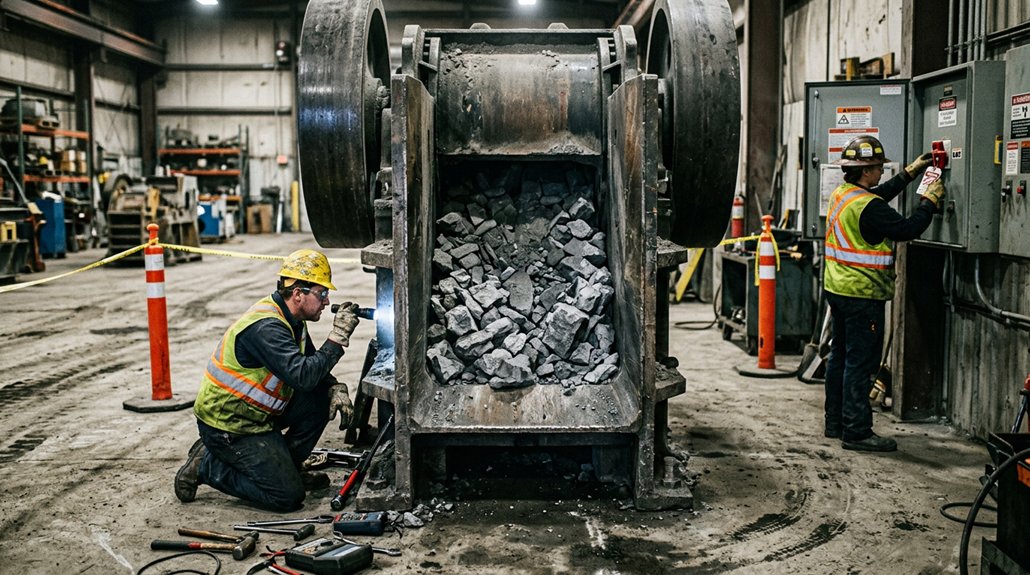
Unplanned crusher stoppages can account for up to 30% of downtime in hard-rock operations, and a jaw jam is often the trigger. Every operator must undergo immediate safety training on what to do when your jaw crusher jams to prevent severe equipment damage and serious injury. When it happens, you can’t treat it like a quick blockage. You need to stop the crusher, lock out and tag out every energy source, and confirm zero motion at the flywheel and toggle before you go near the chamber. Next, you’ll decide whether hydraulic relief is enough or if manual clearing is unavoidable—because your next move determines what breaks, and who gets hurt.
Key Takeaways
- Stop the crusher immediately and apply full lockout/tagout; isolate electrical, hydraulic, and stored mechanical energy, then verify zero energy.
- Inspect from safe access points for bridging rock, tramp metal, or packed fines; establish an exclusion zone and document observations.
- Identify likely causes: oversize feed, wet fines packing, incorrect CSS, worn or misaligned jaw dies, belt slip, or discharge/cheek plate buildup.
- Choose a clearing method based on risk and access: use hydraulic release if available, or remove obstructions with approved tools and lifting devices.
- After clearing, inspect jaw plates, toggles, bearings, and guards, then restart on light load and monitor amperage, vibration, and temperatures.
Stop the Crusher and Lock Out Power

Before you do anything else, stop the jaw crusher immediately and initiate a full lockout/tagout (LOTO) to isolate all energy sources. Shut down the prime mover, lock and tag electrical disconnects, and block stored mechanical energy by securing the flywheels and toggles.
Bleed off hydraulic and pneumatic pressure, then lock valves in the safe position. Verify zero energy: try-start from the control station, test for voltage, and confirm pressure gauges read zero.
Post your LOTO status at the crusher and restrict access to authorized personnel only. Document the stop in the shift log and notify supervision.
This step reinforces Operator training expectations and prevents shortcuts. Don’t restart until you’ve confirmed guards are intact and Lubrication maintenance points aren’t leaking or overheated.
Confirm It’s a Jam (and What’s at Risk)
Although a jaw crusher that quits feeding can look like a simple plug, you need to confirm you’re dealing with an actual mechanical jam—and understand the hazards—before you put anyone near the chamber. After lockout, verify zero motion at the flywheel and toggle, then check that the drive can’t backspin. Inspect from safe access points: look for stalled jaw movement, abnormal jaw gap changes, and signs of jaw alignment shift. Note any Material buildup at the feed chute, jaw faces, or discharge that could mask a jam. Treat stored energy as your main risk: sudden release can eject rock, snap components, or pull tools inward. Document what you see and set an exclusion zone.
| Check | Risk if misread |
|---|---|
| No jaw travel | Stored energy release |
| Gap inconsistency | Pinch/crush points |
| Belt/backspin | Unexpected restart |
| Buildup signs | Ejection/projectiles |
Common Causes of Jaw Crusher Jams
When feed conditions, machine settings, and wear all drift out of spec at once, a jaw crusher can lock up fast. You’ll most often see jams from oversize rock bridging the chamber, wet fines packing the nip, or rebar and tramp metal wedging between the jaws.
Material buildup under the cheek plates or in the discharge area can restrict movement and drive current spikes. Incorrect CSS, worn toggle seats, or misaligned jaw dies reduce bite and promote stalling under load.
Uneven wear on fixed and swing jaw profiles creates a tapered crushing zone that traps material instead of drawing it through. Poor feeder control, segregated feed, and low RPM from belt slip can also starve or surge the chamber and trigger a hang-up.
Choose Hydraulic Release or Manual Clearing
After you’ve identified the likely jam source—bridged oversize, packed fines, or tramp metal—you need to decide whether to use the crusher’s hydraulic release (if equipped) or perform a controlled manual clear.
Favor Hydraulic options when the crusher has rated relief, monitored pressure, and the obstruction can be backed out without exposing you to the chamber.
Choose Manual methods when hydraulics aren’t available, the jam’s geometry is uncertain, or you must verify damage before any movement.
Base the choice on risk, access, and energy state, not speed.
- Picture the toggle area loading up like a bent spring
- Hear relief valves chatter as pressure spikes
- See fines cementing the nip into a solid plug
- Spot shiny tramp metal wedged across jaw faces
Clear the Jam Safely: Step-by-Step
Before you put any force on the crusher, lock the job down: stop the feed, isolate and lock out/tag out electrical and hydraulic energy, and verify zero motion and zero pressure at the flywheel, toggle, and relief circuit.
Barricade the area, post a spotter, and confirm radio communication.
Inspect the chamber from a safe position; never reach in. Remove loose material with long-handled tools or a vacuum system.
If a tramp rock is wedged, use a rated lifting device or clearing hook and apply controlled, incremental force, keeping your body out of the line of fire.
Jog only if your procedure permits and all guards are in place.
Restore energy only after you’ve cleared the cavity, accounted for tools, and documented Jaw crusher maintenance actions for operational safety.
Check Jaw Plates, Bearings, and Toggle Parts
Although the jam may be gone, you still need to verify the crusher didn’t take damage by checking the jaw plates, bearings, and toggle assembly under lockout/tagout. Start with Jaw plate inspection: confirm the fixed and swing plates haven’t cracked, loosened, or galled, and that tooth profiles aren’t folded over from tramp metal.
Then check the cheek plates and fasteners for fretting or fresh metal dust.
- Look for shiny scrape lines across jaw faces, like a dragged chisel
- Feel for heat at bearing housings; compare left vs. right
- Inspect toggle plate/seat for peening, bends, or broken keepers
- Check flywheel and shaft for endplay, grease purge, or blackened lube
Complete Bearing maintenance by verifying correct grease type, clean relief ports, and intact seals.

Reset Settings and Test-Run Under Light Load
After you’ve confirmed the mechanical components are sound, restore the factory control settings so you’re starting from a known baseline.
Verify all safety interlock functions (guards, E-stops, and access switches) and confirm the crusher won’t start with any interlock open.
Then perform a light-load test run, monitoring current draw, vibration, and discharge flow, and stop immediately if alarms or abnormal conditions appear.
Restore Factory Control Settings
When a jaw crusher keeps jamming despite mechanical checks, restore the controller to factory defaults to eliminate misconfigured interlocks, timing values, and protection thresholds. Lock out power, document your current parameters, then load the OEM default file or perform a hard reset per the manual.
Re-enter only essentials (motor nameplate data, sensor scaling) and confirm Jaw lubrication and feed size setpoints aren’t driving nuisance trips. Then test-run under light load, watching trends and alarms before you resume production.
Picture the process as:
- A tagged disconnect, panel door open, meter verifying zero energy
- A laptop on the PLC, defaults loaded, parameters logged
- A slow, even trickle of small rock into the hopper
- A calm HMI, stable current draw, no fault codes
Verify Safety Interlock Functions
Before you put the jaw crusher back into full service, verify every safety interlock works as designed by resetting the interlock states and running a controlled, light-load test.
Start at the HMI/PLC and clear latched trips, then confirm each input returns to a normal state: E-stops, guards, pull-cords, oil pressure, temperature, and motor overloads.
Use system diagnostics to view I/O status, timestamps, and fault history so you can spot stuck contacts, miswired sensors, or bypassed circuits.
Cycle each device one at a time and confirm it blocks start, triggers the correct alarm, and requires a deliberate reset.
Verify permissives too, including lubrication pump feedback and speed/zero-speed signals.
Document results and lock out any failed interlock until repaired.
Perform Light-Load Test Run
With interlocks and permissives proven, you can put the jaw crusher through a controlled light-load test run to confirm the jam-clear procedure didn’t introduce new faults. Reset the CSS, stroke, and drive limits to nameplate values, then jog the motor and verify rotation. Listen for uneven knocking, and watch for belt slip, amp spikes, or hydraulic hunting. Confirm Lubrication maintenance status: oil level, pressure, and temperature must stabilize before any rock enters the chamber.
- You stand at the HMI, alarms cleared, E-stops reset
- You watch the flywheels coast smoothly, guards secure
- You crack the feeder to a low Material feed rate
- You sample discharge, checking size and tramp carryover
If vibration, temperature, or current rises abnormally, stop, isolate, and re-inspect immediately.
Warning Signs and Checks to Prevent Repeat Jams
Although a jam often seems sudden, you can usually spot it developing by watching a few high-risk indicators and running quick, repeatable checks. If amperage climbs, feed rate surges, or discharge slows, reduce feed and lock out before inspecting. Listen for squeal, knock, or belt slip; they signal overload or misalignment. Track vibration and bearing temperature; trend changes often precede seizure.
Prioritize Monitoring wear: measure CSS, check jaw die profiles, and inspect cheek plates and toggle seats for cracking or packing. Verify Lubrication maintenance: confirm grease flow, correct viscosity, clean breathers, and no water contamination.
Inspect tramp relief and magnets, test the pitman for free movement, and confirm guards and fasteners are tight. Document findings and set recheck intervals.
Frequently Asked Questions
What Jaw Crusher Size Is Best for My Material and Throughput?
You’ll pick a jaw crusher sized to your feed top-size and required tph, then verify Material compatibility and Crusher calibration. You’ll target 80% feed under gape, set CSS for product, and maintain safe clearances.
How Often Should I Lubricate a Jaw Crusher Under Normal Conditions?
You’ll lubricate daily for bearings and weekly for toggle/pitman points under normal loads—verify this theory by checking heat and wear trends. Follow your lubrication schedule and maintenance checklist, and don’t grease running equipment; lockout-tagout.
What PPE Is Required When Clearing Jams On-Site?
You must wear Personal protective equipment: hard hat, safety glasses/face shield, hearing protection, cut-resistant gloves, steel-toe boots, hi-vis, and respirator as needed. Follow safety procedures: lockout/tagout, verify zero energy, use tools.
Can I Run a Jaw Crusher Wet, and How Does Moisture Affect Jamming?
Sure, run it wet—if you enjoy downtime; you can, but you’ll raise jamming risk. Moisture effects increase fines adhesion, bridging, and slip. Control feed gradation, reduce clay, and manage water sprays for jam prevention.
When Should I Call the Manufacturer Instead of Attempting In-House Repairs?
Call the manufacturer when you see structural cracks, repeated jams, abnormal vibration, control faults, or warranty issues. You’ll follow manufacturer guidance and prioritize repair safety when lifts, hydraulics, or critical settings exceed your procedures.
Conclusion
When your jaw crusher jams, you stop work, lock out and tag out all energy, and verify zero motion before you touch anything. You confirm the jam’s cause, then choose hydraulic relief or controlled manual clearing with proper tools and rigging. After removal, you inspect jaw plates, toggle components, and bearings, restore lubrication, and reset settings. Finally, you test-run under light load and monitor sound, vibration, and heat—like checking a compass before sailing.