
- Key Takeaways
- How A Rock Crusher Works
- Types of Rock Crushers
- Key Operational Factors
- Modern Crusher Innovations
- The Crusher’s Lifecycle
- Rock Crusher Applications
- Conclusion
- Frequently Asked Questions
- How does a rock crusher actually break rock?
- What are the main types of rock crushers?
- How do I choose the right rock crusher for my project?
- What factors affect rock crusher performance and efficiency?
- How often does a rock crusher need maintenance?
- What safety practices are essential when operating a rock crusher?
- In which industries are rock crushers most commonly used?
Key Takeaways
- A rock crusher works by applying mechanical forces such as compression, impact, or shear inside a designed chamber to break large rocks into smaller, controlled sizes for further processing. Matching the force type and chamber design to rock hardness, abrasiveness, and desired product size is key to reliable performance.
- Core systems like the crushing chamber, feed mechanism and discharge configuration need to work in harmony to provide consistent throughput and stable product gradation. You can often optimize efficiency and machine life through feed-size control, clear discharge pathways and the use of proper liners and wear parts.
- Various types of crushers such as jaw, cone, impact, and gyratory are used for different crushing stages or for particular materials. When choosing a crusher, consider your material characteristics, throughput requirements, and desired output. Then match them to each crusher type’s advantages and disadvantages.
- Operational factors like material, feed size control, and wear parts condition impact energy consumption, product quality, and downtime. You can create a basic checklist encompassing feed consistency, chamber inspections, and scheduled wear part replacement to sustain top performance across the crusher’s lifespan.
- State-of-the-art automation, safety, and energy-efficient designs mean you can operate crushers with higher quality consistency, greater safety, and lower cost to operate. It’s easy to add sensors, automated controls, and remote monitoring to your existing setups and move toward predictive maintenance and smarter process optimization.
- Seeing a rock crusher through its lifecycle — selection, operation, and maintenance — lets you prepare for initial investment as well as long-term cost of ownership. By recording crucial activities, training operators and aligning crusher selection with mining, construction or recycling applications, you can extend equipment lifespan and accomplish more sustainable, economical crushing operations.
===
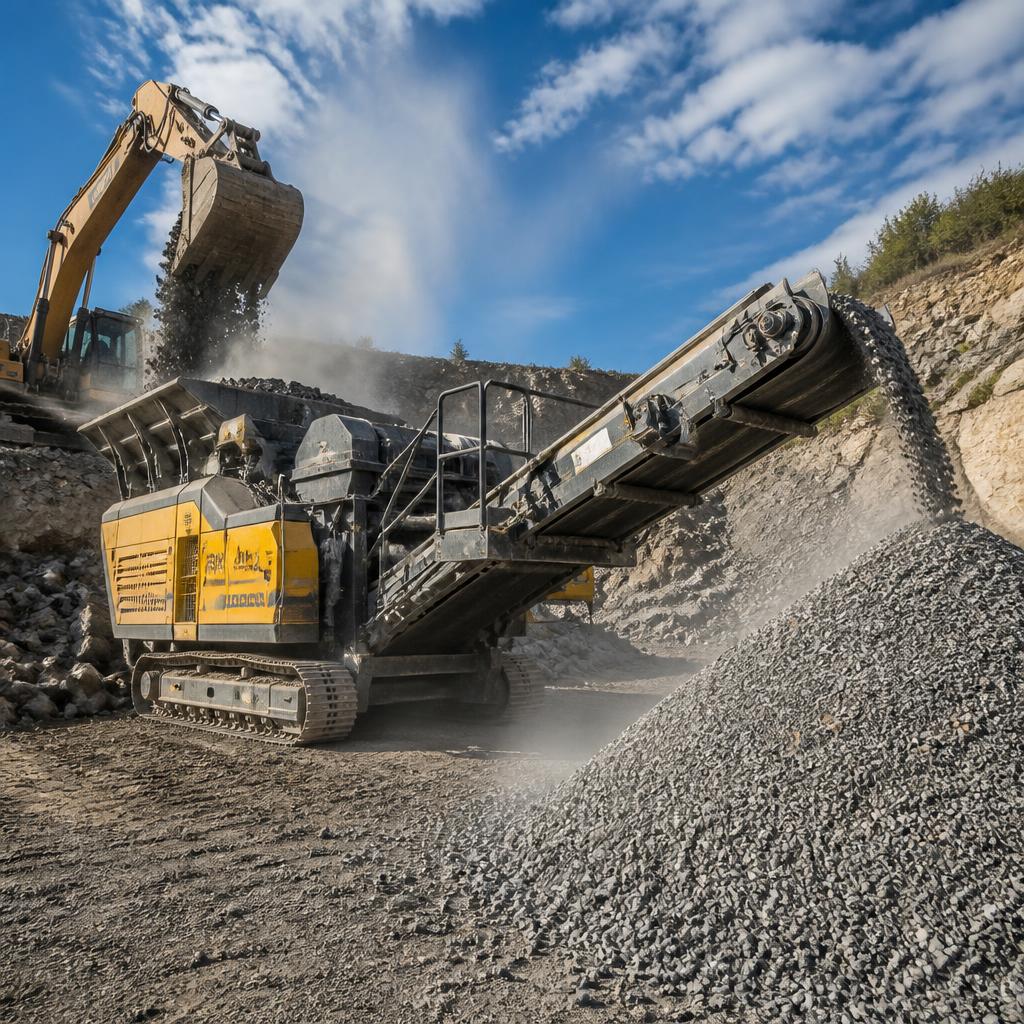
A rock crusher works by applying mechanical force to break large rocks into smaller pieces for use in construction, mining, or recycling.
Machines vary from basic jaw crushers that grind rock between two plates to cone and impact crushers that employ rotating components and high-velocity blows.
Each is best fit for various feed sizes, hardness, and desired outputs.
To provide clear context, the following sections detail key varieties, main components, and sequential crushing phases.
How A Rock Crusher Works
A rock crusher is a machine that uses mechanical force to break large rock and aggregate into smaller, manageable pieces. It does this in a chamber, where a feed system feeds material in and discharge moves crushed material out, so the process can go in a steady stream.
1. The Force
Crushers break rock by the application of compressive, impact, or shear forces until the internal bonding of the rock gives way. To make flakes, you use compression crushing, where the machine squeezes material between two surfaces until it fractures, which tends to give more controlled, less flaky particles.
Impact crushing throws the rock against hard surfaces so it shatters and fractures along natural planes. Jaw crushers are the archetypal compression type. The crushing chamber is composed of two jaw plates: a V-shaped fixed jaw plate and a moving jaw plate. The swing jaw moves toward and away from the fixed jaw, crushing the rock on each stroke.
Cone crushers use compression, but the motion is more continuous, with a cone-shaped head moving inside a concave bowl to crush rock in a narrow annular zone. Impact crushers work in another way. Rotating bars or rotors throw rock against fixed aprons, and the material breaks on contact rather than by slow squeeze.
All of these designs depend on mechanical advantage. A comparatively small motor torque transmitted through gears, flywheels, and eccentric shafts generates high crushing forces at the contact surfaces. The type and level of force matter. Hard, abrasive ores usually go to jaw or cone crushers that use compression, while softer, less abrasive materials often suit impact crushers where higher velocity but lower contact pressure is acceptable.
2. The Chamber
The crushing chamber is designed and lined to funnel rock into the active crushing zones and to dampen the stresses from each impact or compression cycle. Its geometry determines how the rock travels, how often it is pinched and freed, and how fast it leaves after fracturing.
Chamber design varies with crusher type and that in turn changes capacity, reduction ratio, and product shape. A steep jaw chamber is aimed to provide tough primary crushing, frequently accepting feeds that produce 50 to 20 inches (roughly 1,270 to 500 mm) output in primary phases, whereas a more parallel cone chamber focuses on more regulated control of final dimension.
Wear parts are key here. Replaceable liners and jaw plates shield the frame and maintain the chamber profile within design boundaries. As they wear, the breakage pattern and throughput drift, so replacing them promptly preserves performance and energy efficiency.
Chamber size and precise geometry restrict maximum feed size and establish achievable throughput, which is why plant designers pair particular chamber profiles with the rock type and intended product.
3. The Feed
Feed size and consistency control impact how efficiently the crusher operates and its lifespan. Material that fits the chamber right allows every stroke to do productive work and not battle blockages.
Oversized or too irregular pieces can get wedged into the inlet, causing bridging and unplanned stops and accelerating wear on jaw plates or rotor parts. For large or mixed feeds, plants typically employ a pre-screen or a first crusher stage, so the primary crusher sees a more uniform feed stream.
A controlled feed rate, usually via a feeder with speed control, keeps the machine loaded but not overloaded, which stabilizes power draw and results in a more consistent product curve.
4. The Discharge
At the base of a jaw chamber, the jaw plate gap determines maximum output size, called the closed-side setting (CSS), which directly controls final product top size and impacts throughput. Many cone and impact crushers allow operators to adjust their discharge or CSS to move the gradation toward finer or coarser material.
Discharge paths efficiently keep crushed rock moving out of the machine so it does not build up and choke the chamber. After discharge, conveyors move material to the next stage. Powered conveyors use motors and belts or rollers, while gravity conveyors rely on slope and weight alone.
Screens then separate the crushed product into size fractions, directing on-spec material to stockpiles and oversize back to another crusher pass.
Types of Rock Crushers
Rock crushers take many forms. Most modern designs still follow the same basic aim as old querns and mortars: apply enough force to break rock into controlled sizes. In reality, plants stage several crusher types in series so the feed size, hardness, and desired product shape all align with the machine’s specialties.
Main industrial types include:
- Jaw crushers
- Cone crushers
- Impact crushers
- Gyratory crushers
Engineers often compare them in a table that maps type, feed size range, reduction ratio, output shape, and typical roles in a circuit (primary, secondary, tertiary). That sort of side-by-side comparison comes in handy when you want to select equipment for concrete, asphalt, or natural stone and hit specific product sizes or shapes.
Jaw Crushers
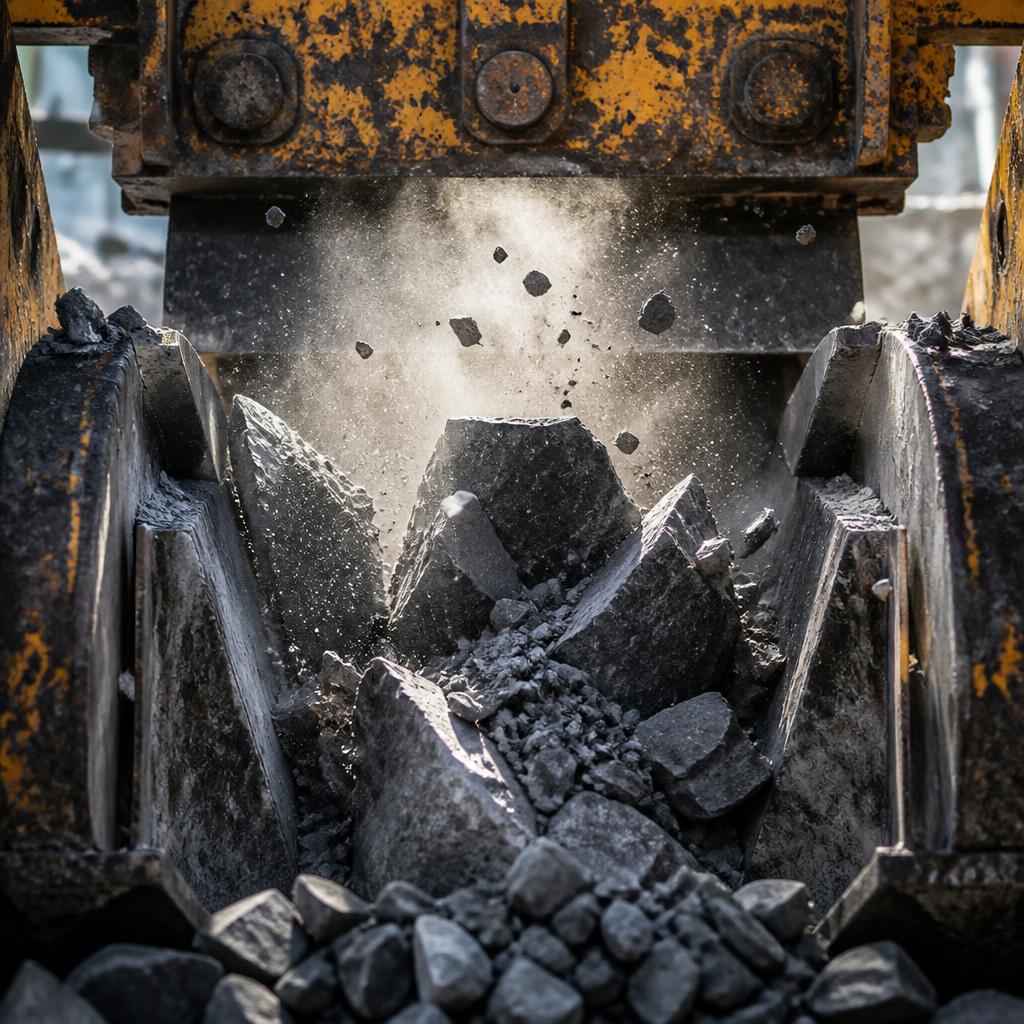
Jaw crushers utilize compressive force for breaking of rock. One jaw is stationary and the other reciprocates, creating a V-shaped chamber. As the movable jaw moves toward the fixed jaw, large blocks of granite, basalt, or recycled concrete get crushed and fracture along natural fissures. They then fall lower for additional crushing.
They’re the workhorse for primary crushing, especially hard, abrasive materials, because the simple compression action is robust and wear parts are easy to swap out. Some mobile jaw units can accommodate rocks up to 1.5 meters (60 inches), making them useful directly at the mine face or demolition location.
Jaw crushers are often grouped by how the swing jaw is pivoted: Blake (pivot at the top), Dodge (pivot at the bottom), and Universal (pivot in the middle). On top of that, you see two main mechanical layouts: single toggle and double toggle. Single toggle designs are simpler and lighter and are common in mobile plants, while double toggle units employ two toggles and a more powerful, albeit slower, crushing action that can suit very tough feeds.
In mining, quarrying, and aggregate production, jaw crushers typically sit at the head of the line and feed downstream cone or impact crushers that complete the shaping.
Cone Crushers
Cone crushers employ a rotating mantle inside a fixed concave liner to crush rock by compression. The gap between the mantle and concave narrows as the mantle moves, so particles are squeezed, broken, and guided downward until sufficiently small to fall out at the bottom.
You typically encounter cone crushers in secondary and tertiary stages, once a jaw or gyratory has already crushed the big pieces. They’re prized for outputting fairly uniform and frequently more cubical aggregates than a jaw alone, which counts for high-quality concrete and asphalt mixes that require stable grain shape.
Design variations include compound cone crushers, which are simple mechanical designs often used where cost control is a priority. Spring cone crushers use springs for overload protection. Hydraulic cone crushers use hydraulic adjustment and tramp relief, which are common in modern high-capacity plants.
Some industry literature includes gyratory crushers in the broader “cone” family, as they use a conical crushing head and a concave shell, albeit of a different scale and duty. For medium to hard stone like basalt, gneiss, and hard limestone, cone crushers deliver steady performance, excellent uptime, and predictable product size, which assists when you require consistent feed for further milling or for tight grading curves.
Impact Crushers
Impact crushers pulverize rock by striking it instead of compressing it. High-speed hammers or blow bars hurl material against impact plates, which are also called breaker plates, fracturing it and often refining particle shape as edges chip off. The output is typically a more angular yet well-graded product.
They work especially well with softer, less abrasive materials such as limestone, some recycled concrete, or asphalt and for situations where final shape trumps brute force reduction of extremely hard rock. Plants sometimes put them in secondary or tertiary positions when they require good surface texture and tight control of fines.
Two main types dominate: horizontal shaft impactors (HSI) and vertical shaft impactors (VSI). HSIs utilize a horizontal rotor with blow bars and are common in concrete and asphalt recycling, where they can ‘open up’ composite material and liberate embedded steel.
VSIs utilize a vertical rotor that throws particles against anvils or a rock bed. The product from a VSI is typically extremely consistent and cubical. That cubical shape is sometimes needed in today’s highway asphalt, where particle geometry plays a role in compaction and long term rutting performance.
Many impact crushers can do concrete, asphalt, and natural stone with the same platform. They are common in mobile units that move between demolition, roadwork, and quarry sites, which are settings tuned to hit the needed product size envelope.
Gyratory Crushers
Gyratory Crusher: Like jaw crushers, gyratory crushers are compression-type machines that crush material between a moving piece of steel and a stationary piece. They sit deep in the plant and take in truck-dumped or conveyor-fed run-of-mine rock that is too big for most other machines.
The heart of the mechanism is a gyrating spindle or crushing head within a steeply conical chamber. As the spindle moves in a small eccentric orbit, it generates a continuous compression zone between the head and the concave liners. Rock is crushed gradually as it descends, enabling high volume and smooth flow without the stop-go style you find in some jaw designs.
Gyratory units can process very large feed sizes and operate effectively on continuous, 24 hour-a-day duty. They commonly constitute the initial stage of bulk material processing prior to the material entering cone or impact crushers for secondary and tertiary stages, where product size and shape become more tightly controlled.
Key Operational Factors
Crusher performance is based on what you feed, how you feed, and how well you protect with the right parts and settings.
Material Properties
Hardness, abrasiveness, moisture and brittleness of the rock or recycled material sit at the heart of crusher selection. Very hard, abrasive rock, like granite or basalt, requires powerful compression machines fitted with heavy-duty liners and jaws. Softer, less abrasive rock crushes very well in impact crushers.
Sticky or wet material, such as clay-rich ore or damp demolition waste, likes to bridge inside chambers and requires machines with open profiles, slower speeds, or specialized pre-screening. The material determines how quickly wear parts break and how frequently you have to pull over for service.
A quartz-heavy feed can chew through jaw plates and mantles a lot faster than limestone with the same feed size. In practice, operators tune engine power and chamber design to hardness and abrasiveness because power determines the maximum throughput. Trying to force hard rock through a low-powered machine just increases operating expenses and downtime.
For new sites, brilliant groups conduct laboratory checks on sample material prior to committing a crusher train. Basic tests on compressive strength, abrasiveness and moisture assist in selecting the appropriate type (jaw, cone, impact or hybrid), the reduction ratio per stage and if they require two or three crushing stages: primary, secondary and sometimes tertiary to achieve the desired size and shape.
Feed Size
Feed size should fit the intake opening and chamber geometry. For a jaw crusher, rock, concrete or demolition debris falls from the hopper into the V-shaped chamber. The swinging jaw moves toward the stationary jaw on every compression stroke, so any boulder too big for the opening can jam or harm the machine.
Uniform feed size maintains a consistent reduction ratio and more uniform output. Wide feed size swings generate load peaks, cause liners to wear, and complicate clean product gradation. Feed degradation occurs when overfeeding, particularly when passing a 70 to 85 percent choke-fed chamber on compression crushers, leads to packing, wear, and downtime.
Many plants incorporate a grizzly or pre-screen to eliminate fines and scalp off oversize before the primary crusher. They tune feeders and conveyors to design capacity, so cones and jaws remain choke fed without falling into overload.
Wear Parts
Core wear components include liners, jaw plates, mantles, toggle plates, blow bars and impact plates, all requiring consistent examination. Preventive maintenance that swaps these components before failure keeps throughput close to design, holds energy use per tonne in check, and cuts the risk of major breakdowns that stop the whole plant.
High-quality, abrasion-resistant alloys, matched to material hardness and abrasiveness, extend these parts’ life and reduce operating costs over the season. Most operators log hours, tonnes processed and wear profile measurements for each parts set.
They maintain a small spare inventory on site so a broken toggle plate or worn mantle doesn’t close production for days. A simple checklist or table helps guide selection and setup: list material hardness and moisture, target product size and shape, stage (primary, secondary, tertiary), engine power, maximum feed size, preferred choke level, and wear-part grade.
Then use that sheet as a quick reference when tuning settings or choosing a new crusher.
Modern Crusher Innovations
Modern rock crushers still rely on compression, impact and shear forces. The manner in which they control those forces has evolved significantly. Today’s jaw, cone and impact crushers employ sensors, automation and superior materials to process more tonnes per hour with narrower product specifications while reducing energy consumption and unplanned shutdowns.
|
Aspect |
Traditional Crushers |
Modern Crushers |
|---|---|---|
|
Control |
Manual settings, local panels |
Automated controls, smart PLCs, remote HMI |
|
Monitoring |
Periodic visual checks |
Real-time sensors, trend data, alarms |
|
Safety |
Basic guards, simple interlocks |
Overload systems, hydraulic release, advanced emergency stops |
|
Efficiency |
Fixed geometry, coarse control |
Optimized chambers, choke feed, variable speed drives |
|
Maintenance |
Long shutdowns, manual inspections |
Quick-change wear parts, predictive maintenance based on data |
|
Mobility |
Mostly fixed plants |
Track-mounted and wheel-mounted mobile units |
|
Product Quality |
Variable gradation, limited fines control |
Finer products, controlled shape and size distribution |
Automation
Automation in today’s crushers revolves around closed-loop control. A controller receives data from load cells, power draw sensors, and level sensors in the crushing chamber. It then adjusts parameters including closed-side setting, feeder speed and in cone units, eccentric speed to maintain the crusher at target load.
This is where choke feeding is kept in a repeatable manner, which stabilizes the bed of rock, increases crushing efficiency and assists in outputting a more consistent size. Automated controls eliminate human error because the system responds in seconds, not minutes.
You see this clearly in cone crushers handling hard ore: instead of an operator guessing when to adjust the gap as wear builds up, the system tracks position and power and adjusts the setting so product size stays within spec over the shift.
Remote operation has become a necessity, not a luxury. Operators can monitor jaw, cone, and impact units from a control room, or in mobile plants from a tablet in a safe room away from dust and noise. This is beneficial in brutal environments and locations with tight safety regulations.
Sensor data is logged and mined. Vibration, temperature, power draw and throughput trends feed predictive maintenance plans. An increase in vibration in a jaw crusher can signal a bearing problem far in advance of its failure, allowing the crew to plan a brief pause and prevent an all-out breakdown.
Safety Systems
Modern safety systems start with design: guards around moving parts, interlocks on access doors, and clearly placed emergency stop stations. In addition, lots of units provide hydraulically released systems in jaw and cone crushers, which open the chamber if uncrushable steel enters, so the machine relieves stress rather than cracking major parts.
Overload protection protects people and machines. When it senses a blockage or power draw spike, it can slow or halt the feeder, open the chamber, and notify the operator. This is particularly valuable in impact crushers operating on softer rock but still encountering random hard inclusions capable of jamming rotors.
Meeting safety standards is a selling point, not an afterthought. They build to or beyond typical mining and quarry standards, including lockout/tagout features, signage, and safe-work zone definitions for mobile crushers that shift around a site.
Training still weighs the most. Frequent drills on emergency stops, clearing blockages, checking wear parts, and safe operation of remote controls enable the crew to operate these systems properly instead of circumventing them when under production pressure.
Efficiency Gains
Efficiency gains show up in several layers at once: newer chamber geometries, better liners, and smarter feeding. Compression crushing in jaws and cones now operates with optimized angles and extended stroke, meaning medium-hard to hard rock smashes with fewer passes and higher crushing ratios.
Along those same lines, impact crushers employ advanced rotor and curtain designs that allow them to work softer materials with better control of fines, which is important in mineral processing where finer products increase recovery.
Wear materials are another silent enhancement. High-chrome, martensitic, and composite liners last longer and many designs allow operators to switch liner profiles to tune product shape. That extended life translates into less scheduled downtime and a reduced cost per tonne, particularly in highly abrasive ores where traditional style liners used to wear out quickly.
Modular parts and quick-change wear components reduce downtime. With modern lifting tools and standardized parts, swapping jaw dies or cone liners can change from a full-day job to a much shorter task, which is crucial for mobile crushers that travel between sites and need to return to work quickly.
To keep these gains real, sites track data such as tonnes per hour, kilowatt-hours per tonne, liner life, and downtime hours. Routine inspections and preemptive parts replacement keep the crushing circuit stable. That stability, in turn, feeds back into increased throughput and a more consistent product.
The Crusher’s Lifecycle
The crusher’s lifecycle, from design and build through years of daily work and repair to final shutdown and recycling. In practice, this lifecycle plays out across three linked stages: selection, operation, and maintenance, all of which decide how long the machine will run and how well it will pay back its cost.
Typical lifecycle activities include:
- Selecting crusher type and size for each material and location.
- Installing foundations, power, and feed systems.
- Training operators and setting up startup/shutdown routines.
- Running daily checks and cleaning critical systems.
- Performing scheduled inspections and part changes.
- Logging faults, repairs, and performance trends.
- Thinking about major rebuilds or full replacement at end of life.
For long projects, name tracking these items in a simple checklist or table in a shared document. This way, engineers, operators, and managers see the same lifecycle picture at a glance.
Selection
Selection begins prior to the machine’s presence on site and often even prior to purchase because the crusher’s lifecycle is influenced by the design and production decisions. Frames, bearings, wear liners, and hydraulics are constructed from particular steel grades and alloys so they withstand constant impact, compression, or abrasion. When you select a model, you implicitly select a certain design philosophy and a certain set of trade-offs.
Crucial inputs are the rock type, desired product, capacity, and location. Hard, abrasive rock with a compressive strength near the top end may require a cone or jaw crusher with strong liners, while softer recycled concrete could be suitable for an impact crusher. If the plant must push up to 2,000 tonnes per hour, you cut the list down to high throughput units. If the site has tight space, dusty wind, or poor access, you tip towards compact layouts and easy service designs, even if the nameplate capacity is lighter.
Manufacturer data sheets, application guides, and reference case studies help translate those needs into a shortlist of models. They indicate safe feed size, power draw, reduction ratio, and how the machine performs with high-hardness feeds, which can wear hammer heads in under 200 hours if you choose the wrong variety. A straightforward selection matrix on a spreadsheet, rating each candidate on capacity, feed size, hardness range, power consumption, and anticipated liner life, clarifies trade-offs and maintains attention on lifecycle cost rather than merely purchase price.
Upfront price can tempt teams to pick a smaller or lighter crusher, but long-term operating costs often dominate. Energy per tonne, liner and hammer changes, unplanned downtime, and the need for full refurbishment when performance drops are important factors. A carefully selected crusher, matched to its duty, can operate for decades with scheduled rebuilds, whereas a mismatched crusher might require premature replacement.
Operation
Operation is where design assumptions run up against real rock, and tiny decisions, day to day, strongly impact the lifecycle. Operators should adhere to the maker’s startup, shut down, and daily check procedures rather than invent shortcuts because those procedures mirror how the bearings, hydraulic circuits, and cooling systems were sized. A quick, cold start with an instant full-load feed, for instance, can shock stresses and shave bearing life.
During each shift, crews should watch a handful of core signals: feed rate compared to the rated tonnes per hour, motor power draw, oil temperature and pressure, and product size or shape. If a plant begins driving significantly above 2,000 tonnes per hour on a crusher sized for less, or if the feed contains oversize boulders or ultra-hard inclusions, then vibration and wear will increase and life will decrease. Daily tasks matter more than many teams expect: checking wear parts, cleaning radiator and oil cooler cores, and testing safety systems help keep both thermal stress and risk down.
Operators need to be able to stop or slow the feed and make adjustments when they notice a drift in product size or a rise in power draw. Closing just too far may provide the correct size for a couple of hours but overload the chamber and cause rapid liner wear. Running too open burns energy and may pass uncrushed material downstream. Good training moves you from “button pusher” to “process owner,” which often cuts downtime, reduces blockages, and lengthens the time before a major rebuild becomes necessary.
Maintenance
Maintenance both mirrors and molds a crusher’s age. Daily cleaning, oil checks, quick glance at wear surfaces, and basic function tests of interlocks and emergency stops maintain the line against unexpected failures and keep operation steady. They detect trouble early, like hot bearings, clogged coolers, or unusual noise that could indicate cracked liners or loose fasteners.
Wear profiles, clearances, and alignment are reviewed in short-interval inspections, often weekly or monthly. If teams disregard early wear, ultra-high hardness material can sand hammer heads or liners down so quickly that impact surfaces will fail and begin to damage rotors, shafts, or housings. The cost of timely replacing worn parts is important, but delaying can turn a stat-p into a long outage with secondary damage that is much more costly.
Annual tune-ups typically go beyond that and should include a comprehensive check-up of lurking dangers and an “in-depth refurbishment” strategy. For a lot of sites, that translates to yanking major components, inspecting frames for fatigue, swapping out main hydraulic hoses and essential attachments, and determining if a partial overhaul is sufficient to return performance. All of this should be logged: dates, parts, faults, repair actions, and measured changes in throughput or power draw.
Those records inform you when the machine has transitioned out of “normal aging” into a phase where even exceptional maintenance cannot retain performance and a complete rebuild or new crusher is a more reasonable choice. All crushers become less efficient over time as wear surfaces wear away and tolerances open up, even with OEM or top-quality aftermarket parts.
With tend and repair cycles, many run for decades before coming to the true end of life. By this stage, the ultimate “maintenance” step is decommissioning, which should involve safe dismantling and whenever feasible, recycling of steel and non-ferrous materials in accordance with environmental regulations and corporate policy.
Rock Crusher Applications
Rock crushers sit at the center of three major industries: mining, construction, and recycling. In each setting, they utilize either compression, impact, or friction to fracture rock, concrete, and demolition debris to controlled sizes, ranging from large chunks for primary crushing down to fine aggregates in tertiary and even quaternary stages.
-
Rock crusher leads to jaw crusher, which is used for primary ore breaking, hard rock mining, and coarse demolition.
-
Gyratory crusher is a high-throughput primary crusher used in large mines and quarries.
-
Cone crusher is used for secondary and tertiary crushing in mining and aggregate plants.
-
Impact crusher (HSI/VSIs) → asphalt, concrete recycling, shaping aggregates.
-
Mobile jaw/impact units are used for on-site construction and small to mid-scale recycling.
For planning or design work, it generally assists to construct an applications chart that connects each crusher type, such as a 30-ton mobile jaw versus a fixed 200-ton gyratory, to its preferred sector application, target feed size, and target output gradation.
Mining
In mining, crushers smash run-of-mine ore into smaller pieces so mills, flotation cells or leach circuits can work on mineral, not host rock. Jaw and gyratory crushers take on most primary work because they use compression crushing, a slow but high-force squeeze between two surfaces that fractures very hard rock with good precision.
Large mines prefer high-capacity, very rugged machines, as they may operate 16 to 24 hours per day and grind through thousands of tonnes per hour. These sites tend to feed a gyratory with haul trucks and then feed cone crushers in secondary and tertiary stages to meet tight size limits for grinding efficiency.
Crushers connect to conveyors, surge bins, and multi-deck screens so ore moves in a loop, with the crushing chamber maintained at approximately 70 to 85 percent fullness. Underfeeding wastes capacity, while overfeeding causes jams, excess wear, and downtime.
Construction
In construction, crushers primarily transform rock into gravel for road base, concrete, and asphalt. Output size is important since bad gradation can weaken concrete or create uneven pavement performance. Operators adjust closed-side settings and screen setups to keep the particle-size curve within spec.
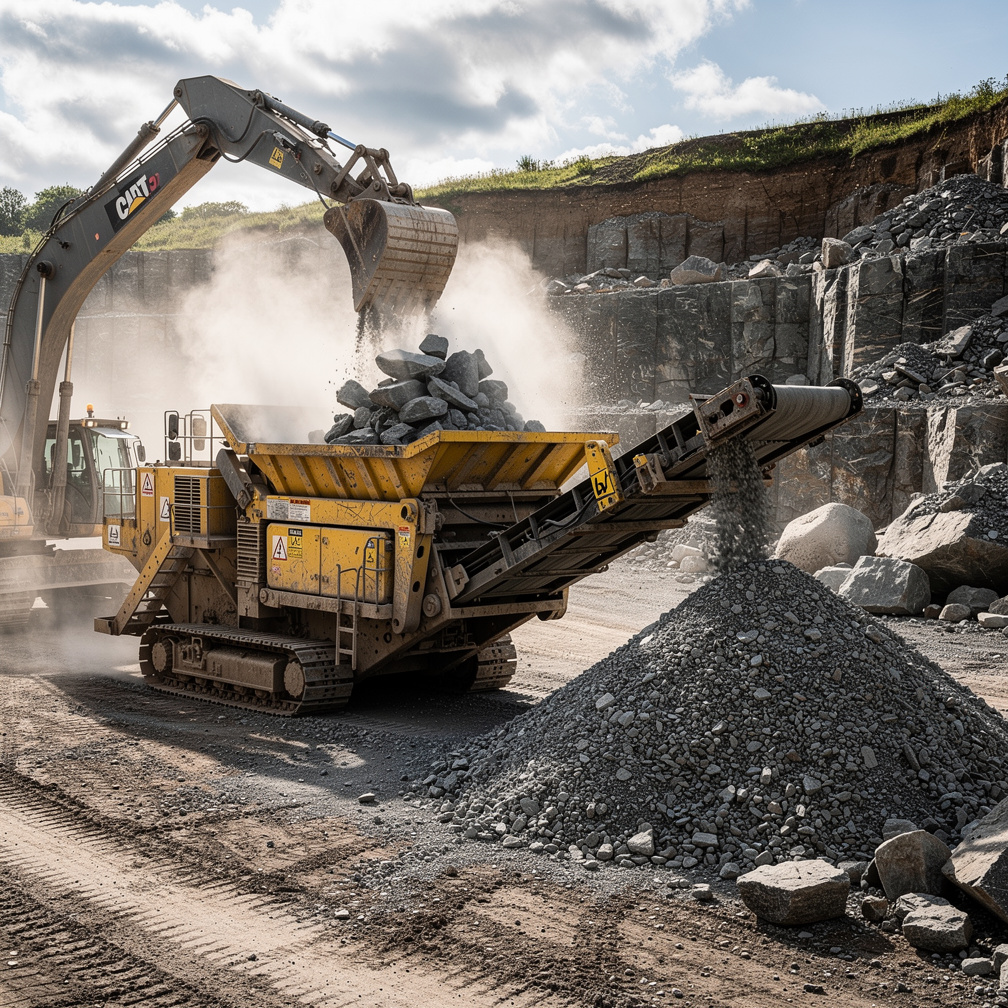
Mobile rock crushers, ranging from light units of a few tonnes up to full tracked units, provide contractors the ability to crush on site during demolition or road work. That reduces truck hauls, conserves fuel and allows them to recycle on the same job, even in constrained urban locations or remote road jobs where access is limited.
Recycling
In recycling, crushers crush demolition debris, concrete, and asphalt into reusable aggregate instead of landfill. We see impact crushers here as well. They hurl material against fixed aprons and shatter it on contact, which is great on softer concrete and asphalt and produces a more cubical product that compacts well under new pavements.
Reinforced concrete requires units that can manage steel rebar without frequent interruptions. Plenty of mobile jaw and impact crushers come with magnets and rebar deflectors, but jaw plates still require care. In compact mobile units, those plates can last anywhere from around 500 to over 3,000 operating hours, depending on feed hardness, fines content, and maintenance discipline.
Recycling setups often pair a crusher with a screener and stacker conveyors to close the loop. Oversize goes back for another pass, while in-spec material moves straight to stockpiles.
Dust control is important in all these applications, but particularly on mixed-debris sites. Uncontained dust irritates workers’ eyes and lungs and can drift to nearby houses or businesses, so systems frequently supplement with water sprays, enclosures, or vacuum filters.
Conclusion
A rock crusher appears to be nothing complicated from the outside. Up close, it displays concentrated power, intense pressure and clever engineering. Steel pieces impact, compress, and pulverize tough stone. Gears, shafts, liners and wear parts transform raw blocks into crisp, set sizes.
Each type has an obvious task. Jaw units get the first strike. Cone and impact units sculpt and polish. Screens and feeders connect all stages into one flow.
Nice flatscreen TVs, that sort of thing. Smart setup, consistent feed, and genuine safety care lead to great results. Longevity means clean lube, tight checks, and quick replacement of worn components.
Ready to take it further? Choose one crusher type that matches your workload and trace one complete run. Then try it out on a real case.
Frequently Asked Questions
How does a rock crusher actually break rock?
How a rock crusher works. Moving parts, such as jaws, cones or rotors, crush or impact the rock against a stationary plate. This battering breaks the rock apart to the appropriate size and then it falls through a discharge opening.
What are the main types of rock crushers?
The three main types are jaw crushers, cone crushers, and impact crushers. A jaw rock crusher works by using a pair of jaws that crush material between them. Cone crushers give secondary and tertiary crushing. Impact crushers employ high-speed impact for shaping and fine crushing. Each is suited for varying materials, capacities, and end results.
How do I choose the right rock crusher for my project?
Begin with your material type, feed size and output size required. Think about your capacity needs, available power, desire for mobility and budget. For the majority of applications, pair a primary crusher with a secondary unit. Ask manufacturer data and application experts to pair crusher design to your production goals.
What factors affect rock crusher performance and efficiency?
Important parameters are feed size, material hardness and moisture content, crusher speed, closed-side setting and liner condition. Regular feed and appropriate settings increase throughput and product shape. Routine inspection and maintenance prevent unscheduled downtime and keep energy usage and wear costs in check.
How often does a rock crusher need maintenance?
Basic inspections should be done daily or weekly. Lubrication, wear part checks, and adjustments are typically performed every few hundred operating hours. Major overhaul and liner changes are a function of material abrasiveness and production hours. Keeping up with the OEM maintenance schedule prolongs crusher life and prevents failures.
What safety practices are essential when operating a rock crusher?
Operators must adhere to lockout/tagout procedures, employ guards and emergency stops, and don the proper personal protective equipment. Never stick your hand into a crusher that’s operating. Keep walkways clear and practice good housekeeping. Educate employees on safe start-up, shutdown, and block clearing to minimize accidents.
In which industries are rock crushers most commonly used?
Rock crushers find extensive application in mining, quarrying, construction, demolition recycling, and aggregate manufacturing. They create foundations for pathways, tracks, cement, and blacktop. They underpin industrial processes that demand particular rock sizes, like those used in cement, chemical, and metallurgical applications.